When you sleep, your fascia undergoes a process called “re-hydration through rest.” During the day, gravity and movement “squeeze” the fluid out of your fascial chains like water out of a sponge. At night, that fluid is supposed to seep back in, but if you sleep in a position that keeps a chain “clamped,” that section of the sponge stays dry.
This is why you wake up feeling like a “stiff board”—you’ve essentially spent eight hours “setting” your fascial mold.
1. The “Default Mold”: How Your Chains Sleep
Most of us have a favorite position, and that position dictates which chains get “glued” overnight.
- The Fetal Position (The SFL Clamp): Sleeping curled up keeps the Superficial Front Line (abs, chest, hip flexors) in a shortened state. You wake up with “rounded shoulders” because the front of your “wetsuit” has shrunk.
- The Stomach Sleeper (The Spiral Line Twist): Since you have to turn your head to breathe, you spend eight hours putting a massive torque on your Spiral Line. This is a primary cause of “stiff neck” and one-sided lower back pain.
- The Side Sleeper (The Lateral Line Sag): Without support, your top hip “falls” toward the mattress, putting the Lateral Line on a constant stretch while the bottom side is compressed.
2. The “Pre-Sleep Hydration” Hack
To ensure your fascia re-hydrates properly, you need to “un-clamp” the chains before you hit the pillow.
- The 2-Minute “De-Load”: Spend two minutes on the floor in a “Starfish” position—arms and legs wide.
-
- Why: This opens the Functional Lines and the Lateral Lines, taking the “day’s work” off the joints before you go stationary.
- The “Vagus” Breath: Take five slow breaths where the exhale is twice as long as the inhale.
-
- Why: This signals the Deep Front Line (diaphragm and psoas) to stop “guarding.” If you go to sleep stressed, your psoas stays tight, and your lower back will ache by 3:00 AM.
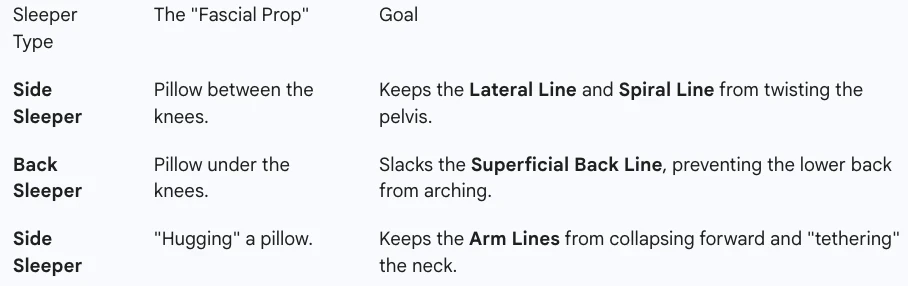
3. “Propping” the Tensegrity
You can use pillows to create a “neutral” environment where the chains can hydrate evenly.
4. The “Morning Flush” (The First 60 Seconds)
The moment you wake up, your fascia is “gel-like.” It needs heat and movement to turn back into “fluid.”
- The Full-Body Yawn: Don’t just sit up. Reach your fingers and toes as far apart as possible while still in bed. This “tensions” the SFL and SBL simultaneously, “waking up” the entire system.
- The “Hydration” Glass: Drink 8–12 oz of water immediately. You cannot re-hydrate your fascia if your blood volume is low.
Summary of the Recovery Window
- 0–2 Minutes Pre-Sleep: Reset the “X” (Functional Lines).
- 8 Hours Sleep: Prop for neutrality (LL and SL protection).
- 1 Minute Post-Wake: Full-body tension and hydration.