Since we aren’t using clinical diagnostic tools, we have to look for the “body’s breadcrumbs.” Your fascia doesn’t have a “check engine” light, but it does have a specific set of whispers that turn into shouts if ignored.
Knowing when to reset is about noticing when your “wet suit” has become a “straitjacket.”
The “Fascial Fatigue” Checklist
If you check more than two of these boxes, your chains are likely “glued” and in need of a dedicated reset:
- The “Morning Creak”: You feel 20 years older for the first 10 minutes after waking up. This is the Superficial Back Line (SBL) being dehydrated.
- The “One-Sided” Mirror: When you stand in front of a mirror, one shoulder looks lower, or your belt buckle points slightly to the left. This is a Spiral Line (SL) or Lateral Line (LL) torque.
- The “Breath Barrier”: You feel like you can’t take a “full” breath into your belly. This is the Deep Front Line (DFL) clamping down around your diaphragm.
- The “Pointy” Pain: You have a specific, “stabbing” spot (like under a shoulder blade or on the side of a knee) that doesn’t go away with a massage. This is a Fascial Adhesion—a spot where two chains are supposed to slide past each other but are stuck together.
- The “Loss of Bounce”: You feel “heavy” when you walk or run. Your fascia has lost its Tensegrity (elasticity), and your muscles are doing 100% of the work.
How Long Does a Reset Take?
The timeline for a “reset” depends on whether you are talking about Nervous System relief or Structural change.
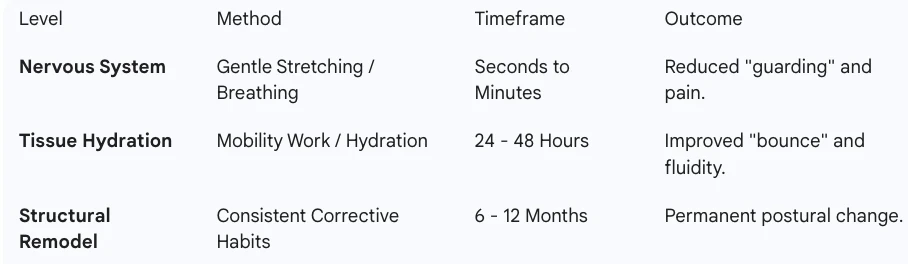
1. The “Immediate” Reset (2–10 Minutes)
- What happens: You are “down-regulating” your nervous system. By doing a slow twist or a deep lunge, you tell your brain it’s safe to let go of defensive guarding.
- The result: Immediate relief. Your range of motion increases instantly. This is great for “barn-side” or “court-side” fixes, but it’s temporary.
2. The “Hydration” Window (24–48 Hours)
- What happens: Fascia is like a sponge. When you compress it (through rolling or movement) and then release it, fresh fluid rushes back in.
- The result: This is the “feel-good” window after a mobility session. It takes about a day or two for the tissue to fully “re-hydrate” and regain its bounce.
3. The “Structural” Remodel (6–24 Months)
- What happens: Fascia is slow to change. It’s made of collagen fibers that are constantly being laid down based on how you move.
- The result: If you’ve spent 10 years as a “lopsided” stable hand, it won’t take 10 years to fix, but it will take months of consistent, varied movement to literally “re-weave” the fabric of your body.
The “Golden Rule” of the Reset
You cannot “force” fascia to change. If you push too hard (like aggressive foam rolling that makes you bruise), your body treats it as a trauma and the chains will actually tighten to protect you.
The goal is “Persuasion, not Invasion.”
Summary Table: Reset Timelines