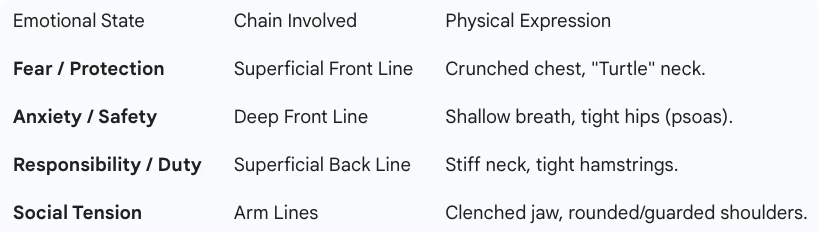
Our fascia isn’t just a mechanical system; it’s our “emotional skin.” It is the tissue that bridges the gap between a thought and a physical reaction. When you experience stress, your brain doesn’t just send a signal to your “mind”—it sends a signal to your tensegrity.
Stress is essentially a “system-wide tightening” that targets specific chains based on our primal survival instincts.
1. The “Startle Response”: The Superficial Front Line (SFL)
This is the most primal reaction we have. When you are startled or under sudden pressure, your body wants to protect its soft, vulnerable front (your throat, heart, and belly).
- The Lock: The SFL (from the toes to the neck) “crunches” shut.
- The Physical Result: This creates the “turtle” posture—shoulders up, chest collapsed, chin forward.
- The Psychology: Chronic stress keeps you in a state of “perpetual protection.”1 You might feel guarded, defensive, or like you’re constantly “bracing” for bad news.
2. The “Seat of Anxiety”: The Deep Front Line (DFL)
The DFL is the “internal” chain. It includes the psoas (the fight-or-flight muscle) and the diaphragm.
- The Lock: When you feel anxious or “on edge,” the psoas and diaphragm tighten.2
- The Physical Result: Your breathing becomes shallow (chest breathing) and your lower back begins to ache. Because the psoas is buried deep in the hip, this “lock” can make you feel “stuck” or “heavy.”
- The Psychology: The DFL is closely tied to our sense of safety. A “locked” DFL often correlates with a feeling of being “unable to move forward” in life or feeling deeply unsettled.
3. The “Burden” Chain: The Superficial Back Line (SBL)
The SBL is our “upright” chain. It’s what keeps us standing against gravity.
- The Lock: When you feel overwhelmed by responsibility—the “weight of the world on your shoulders”—the SBL (heels to brow) becomes hyper-toned.
- The Physical Result: Chronic tension in the calves, hamstrings, and especially the base of the skull (the sub-occipitals).
- The Psychology: This is the “stoic” lock. It’s the body’s way of saying, “I have to stay standing, no matter what.” It often leads to “burnout” because the chain is working so hard to keep you from collapsing.
4. The “Social Guard”: The Arm Lines
Our arms are our primary tools for “reaching out” or “pushing away.”
- The Lock: If you are in a social environment that feels “unsafe” or confrontational, the Front Arm Lines (biceps and chest) tighten.
- The Physical Result: Crossed arms, clenched fists, or “white knuckles.”
- The Psychology: This “tethers” your chest and neck. It makes it physically difficult to be “open” or “vulnerable” with others because your fascia is literally holding you in a closed, defensive loop.
How to “Unlock” the Psychology
Because the mind and the fascia are a two-way street, you can use the body to change the mood.
- To Quiet Anxiety (DFL): Deep, “low” belly breaths. Focus on the exhale. This manually forces the diaphragm and psoas to let go, signaling to the brain that the “threat” is over.
- To Feel Open (SFL/Arm Lines): The “Goalpost” stretch.3 Open your arms wide and lift your chin. This exposes the “vulnerable” front, telling your brain that you are safe enough to be “un-guarded.”
- To Reduce Overwhelm (SBL): The “Ragdoll” hang. Fold forward and let your head be heavy. This takes the “work” off the SBL and lets gravity take the “burden” for a moment.
Summary: Emotional Fascial Mapping