Kinstretch and similar mobility systems are like “software updates” for your fascia. While sports use these chains to perform, Kinstretch goes into the “code” to ensure every joint has the capacity to move before the chains even fire.
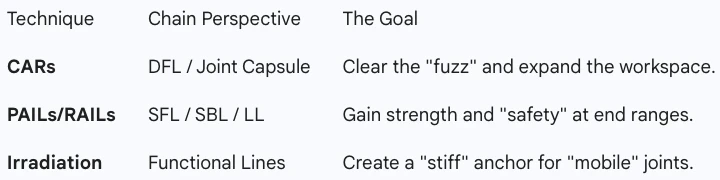
In this world, we focus on CARs (Controlled Articular Rotations) and PAILs/RAILs, which target the deep tissue right at the joint capsule—the very start of the Deep Front Line.
1. The “Joint Capsule”: The Deep Front Line (DFL)
Kinstretch is obsessed with joint “workspace.” Most fascial chains start and end near a joint, but the DFL is the “innermost” map.
- The Action: When you do a Hip CAR (circling the hip), you are clearing the “fuzz” (adhesions) out of the joint capsule.
- The Benefit: This “wakes up” the Deep Front Line. If the hip joint itself can’t rotate, the fascia further up the chain (like the psoas) has to work twice as hard to stabilize you.
- The Risk: Doing high-intensity sports without this “workspace” is like trying to run a high-end app on an old, glitchy operating system. You’ll eventually crash (get injured).
2. The “End Range”: The Superficial Lines (SFL/SBL)
Kinstretch uses PAILs and RAILs (isometric loading at your furthest stretch) to tell your nervous system that it is safe to be in a long position.
- The Action: If you are in a deep hamstring stretch (SBL) and you contract your muscles against resistance, you are “re-mapping” that line.
- The Benefit: Most people are “tight” because their brain is afraid of the end range. Kinstretch “convinces” the Superficial Back Line and Superficial Front Line to let go of their defensive guarding.
- The Result: You don’t just get flexible; you get strong in those flexible positions.
3. The “Full Body Tension”: The Functional Lines (FL)
Kinstretch often uses “irradiation”—squeezing your fists or your core to create tension in the rest of the body while moving one specific joint.
- The Action: This utilizes the Functional Lines to create a “stable anchor.”
- The Benefit: By tensioning the “X” of your body, you isolate the joint you’re working on. It teaches your fascia how to be “stiff” in the center so the “limbs” can be mobile.
- The Insight: This is the secret to power. If you can’t stabilize your core (FL) while moving your shoulder, you’ll never have a powerful golf swing or a stable handstand.
4. The “Ribcage Independence”: The Spiral Line (SL)
Many Kinstretch moves involve “segmental” movement—moving one vertebra at a time or rotating the ribs while the hips stay still.
- The Action: This is a direct “de-gluing” of the Spiral Line.
- The Benefit: It prevents the “block” movement where your whole torso moves as one stiff unit.
- The Result: For a golfer, a stable hand, or a dressage rider, this “dissociation” is the difference between grace and clunkiness.
The “Kinstretch” Mini-Routine (The 5-Minute “Oil Change”)
Do these daily to keep the “software” running smoothly.
- Neck CARs (SBL/SFL): Very slowly, draw the largest circle possible with your chin, feeling the tension move from the front of your throat to the base of your skull.
-
- Why: It keeps the top of the Back and Front lines from “tethering” your head.
- Standing Hip CARs (DFL/LL): Hold onto a post. Lift one knee, rotate it out to the side like a “dog at a fire hydrant,” and circle it back and down.
-
- Why: It clears the workspace for the Deep Front Line and Lateral Line.
- Cat-Cow Segmentation (SBL/SFL): On all fours, try to move your spine one “link” at a time, starting from the tailbone and ending at the head.
-
- Why: It ensures the Back and Front lines are “sliding” over the spine instead of being stuck.
Summary for the Mobility Athlete