A landscape photographer is a “weighted explorer.” Unlike a studio photographer, you are traversing uneven terrain, often while carrying a heavy tripod and a pack that pulls on your center of gravity. You then spend long periods in “static holds”—waiting for the light in a crouch or a twisted position to get the perfect angle.
Here is how the chains react to the “Wait for the Light” lifestyle.
1. The “Heavy Pack” Pull: The Superficial Back Line (SBL)
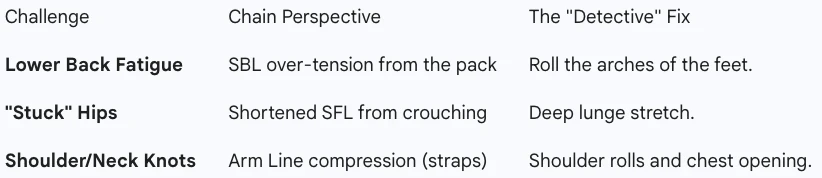
A camera bag loaded with lenses acts as a constant anchor pulling your shoulders back and down.
- The Culprit: To keep from falling backward, your SBL (from your heels to your brow) has to “clamp down.”
- The Result: The muscles along your spine and the backs of your legs stay in a state of high tension. When you take the pack off, you might feel a “rebound” ache in your lower back or a stiff neck because the cable was pulled tight for miles.
2. The “Low-Angle” Crouch: The Superficial Front Line (SFL)
Getting the camera low to the ground for foreground interest often means deep squats or kneeling.
- The Culprit: The SFL (quads and hip flexors) is held in a shortened, compressed state while you focus.
- The Result: The front “wetsuit” gets tight. When you stand up to hike to the next spot, your hips feel “locked,” which forces your lower back to do more of the work during the walk.
3. The “Tripod Carry”: The Lateral Line (LL)
Most photographers carry their tripod in one hand or strapped to one side of their pack.
- The Culprit: This creates an asymmetrical load on the Lateral Line. You lean slightly away from the weight to balance yourself.
- The Result: One side of your waist and outer hip is “crunching” while the other is “stretching.” Over a long hike, this leads to that one-sided hip ache or “IT Band” tightness on the leg that is doing the extra stabilizing.
4. The “Viewfinder Twist”: The Spiral Line (SL)
When you’re adjusting your tripod or looking through the lens at an awkward angle, you are often twisting your torso while your feet stay planted in the mud or on a rock.
- The Culprit: The Spiral Line is “wrung out” to hold that position.
- The Result: If you always rotate to the same side to check your settings or look at the horizon, your torso becomes “pre-twisted.” This can make your gait feel clunky and uneven when you start walking again.
The “Golden Hour” Recovery
Do these when you get back to the car or the trailhead to “un-mold” from the gear.
- The “Pack-Free” Chest Opener (Arm Lines): After taking off your bag, interlace your fingers behind your back and gently lift your hands.
-
- Why: It reverses the “strap compression” on your shoulders and opens the chest to let you breathe deeply again.
- The “Tree-Trunk” Calf Stretch (SBL): Find a rock or a tree root, put the ball of your foot on it, and lean forward.
-
- Why: It releases the “hiking tension” in the SBL, which is the primary cause of those post-hike lower back aches.
- The “Diagonal Reach” (Spiral Line): Reach your right hand toward the sky and your left hand toward your opposite back pocket. Switch sides.
-
- Why: It “un-wrings” the Spiral Line and resets your torso after carrying lopsided gear.
Summary for the Landscape Photographer