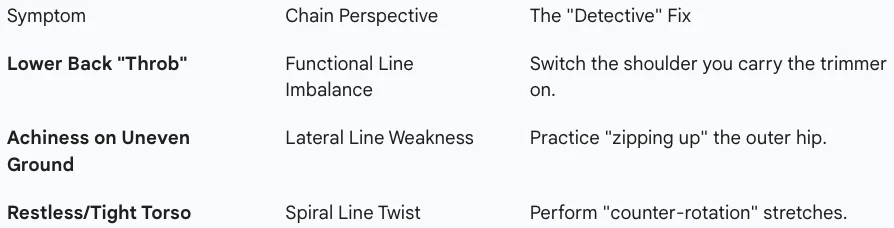
A landscaper is a “Global Mover.” Unlike a dog groomer or a barista who deals with micro-tension, a landscaper deals with massive, shifting loads. You are constantly moving from uneven dirt to hard pavement, lifting heavy bags, and managing powerful vibrating machinery like leaf blowers and weedwhackers.
Your body is essentially a “Torque Machine.” Let’s see how the chains handle the heavy lifting and the uneven ground.
1. The “Heavy Carry & Mow”: The Functional Lines (FL)
Whether you’re pushing a heavy commercial mower or carrying a sack of mulch, you are relying on the “X” of your torso.
- The Culprit: The Back Functional Line (connecting the shoulder to the opposite glute). If you carry a trimmer on your right shoulder all day, your left glute is actually doing the stabilizing work.
- The Result: If this “X” is out of balance, the force of the carry doesn’t go into your hips—it gets “stuck” in your lower back. This is why landscapers often have a “bad side” of their back that feels like a constant throb.
2. The “Uneven Ground”: The Lateral Line (LL)
Landscapers rarely work on flat surfaces. You are on slopes, in garden beds, and stepping over debris.
- The Culprit: The Lateral Line (the side-seam). This chain is your “balance beam.” It keeps your knee and hip from collapsing when you step into a hole or walk along a hillside.
- The Result: If the LL is “gluey” or weak, your knees take all the rotational stress of the uneven terrain. This leads to that “achiness” on the outside of the knee or hip after a long day of outdoor work.
3. The “Shovel & Rake”: The Spiral Line (SL)
Raking and shoveling are repetitive “wringing” motions.
- The Culprit: The Spiral Line. You likely always rake with one hand forward and rotate your body in one direction.
- The Result: You are “winding up” your Spiral Line in one direction for thousands of reps. This creates a “twist” in your resting posture. When you try to sleep at night, your body feels like it can’t quite “unwind,” leading to restless legs and back stiffness.
4. The “Vibrating Tool” Grip: The Arm Lines
Leaf blowers and hedge trimmers send constant high-frequency vibrations through your hands.
- The Culprit: The Arm Lines. Vibration causes the fascia to “toughen” as a protective measure.
- The Result: The “grip tension” travels up the arm and “tethers” the neck. This is why landscapers often feel like their neck is “stuck” or that their shoulders are hiked up to their ears by the end of the shift.
The “End-of-Day” Landscaper Reset
Perform these while you’re putting your tools away or when you get home to “un-mold” the day’s work.
- The “Tailgate Twist” (Spiral Line): Sit on the back of your truck or a chair. Keep your hips square and rotate your chest as far as you can to one side, then the other.
-
- Why: It “un-wrings” the spine after hours of one-sided raking or shoveling.
- The “Sloped Leg” Stretch (Lateral Line): Stand with one foot on a curb and the other on the street. Lean your hips away from the higher foot.
-
- Why: It opens the “side-seam” that gets crunched while walking on uneven slopes.
- The “Vibration Flush” (Arm Lines): Shake your arms out vigorously for 30 seconds, then stretch your fingers wide and make a tight fist 10 times.
-
- Why: It breaks up the “static” tension left behind by vibrating machinery.
Summary for the Landscaper