A wildlife photographer’s physical profile is similar to a landscape photographer’s, but with two major “force multipliers”: extreme stillness and extreme weight.
While a landscape photographer might move their tripod every few minutes, a wildlife photographer might spend two hours frozen in a single position, supporting a $600mm lens. This creates a state of isometric “holding” that can be more taxing on the fascia than actual movement.
1. The “Long Lens” Lever: The Arm Lines
Holding a heavy lens to your eye—or even keeping your hand ready on the shutter—creates a massive lever effect.
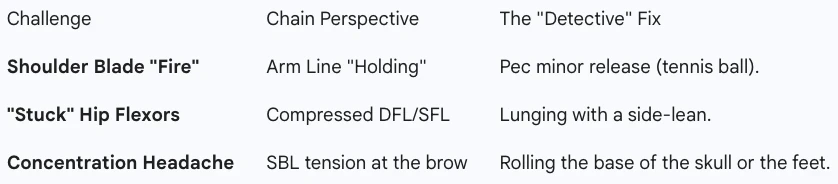
- The Culprit: The Deep Front Arm Line (thumb/biceps) and the Superficial Back Arm Line (triceps/top of shoulder) are in a constant “tug-of-war” to keep the lens steady.
- The Result: This tension “locks” the shoulder blade against the ribcage. It feels like a hot, stabbing pain between the shoulder blades or a “frozen” feeling in the neck. Your body is essentially trying to turn your arm into a tripod.
2. The “Predator Crouch”: The Deep Front Line (DFL)
Wildlife photographers often stay low to the ground to avoid being seen, frequently sitting in a “deep squat” or a “tummy-crawl” position.
- The Culprit: This compresses the Deep Front Line—specifically the psoas and the diaphragm.
- The Result: Because you are trying to stay silent, your breathing becomes very shallow. This “shallow breathing” combined with a compressed DFL leads to a “clamped” pelvic floor and tight hip flexors. When the “stalk” is over, your hips feel like they’ve been glued shut.
3. The “Glass Eye” Strain: The Superficial Back Line (SBL)
Peering through a viewfinder (or even a high-res screen) for hours involves a subtle forward-tilt of the head.
- The Culprit: The SBL at the base of the skull (the sub-occipitals).
- The Result: The fascia at the top of the SBL becomes incredibly tight. Because this line runs all the way to your feet, this “neck tension” can actually cause your lower back to feel stiff. It’s the “viewfinder headache” that feels like a band tightening around your brow.
4. The “Uneven Wait”: The Lateral Line (LL)
When you’re out in the bush, you aren’t sitting in an ergonomic chair. You’re leaning against a tree, sitting on a slanted rock, or kneeling on one knee.
- The Culprit: The Lateral Line (the “side-seam”).
- The Result: You likely have a “dominant” side you lean on while waiting for the animal to appear. This collapses one side of your ribcage toward your hip. By the time you get back to camp, you might feel like your “ribs are touching your hip bone” on one side.
The “Back-to-Base” Wildlife Reset
After a long “stakeout,” your fascia needs to be “re-hydrated” with movement.
- The “Slow-Motion Shake” (Arm Lines): Stand up and let your arms hang. Shake them out very slowly and gently, as if you’re shaking water off your fingertips.
-
- Why: This breaks the “isometric freeze” in the Arm Lines and reminds the nerves that the “holding” is over.
- The “Wide-Knee Child’s Pose” (DFL & SBL): If you were crouched or crawling, get on the ground, bring your big toes together, knees wide, and sit back on your heels. Reach your arms far forward.
-
- Why: This “un-bunches” the Deep Front Line and gives the Back Line the length it lost while you were hunched over the camera.
- The “Jaw Release” (SBL/DFL): Open your mouth wide and move your jaw side to side.
-
- Why: Focus and concentration (waiting for the “shot”) cause us to clench our jaw. Since the jaw is an anchor for both the SBL and DFL, releasing it relaxes your whole spine.
Summary for the Wildlife Photographer