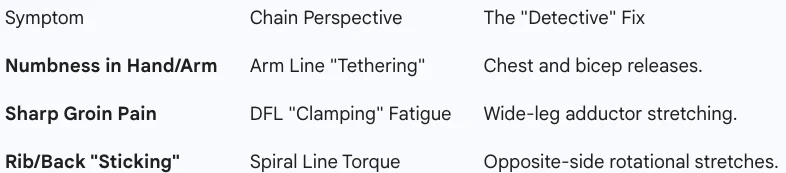
Bull riding is the ultimate test of the Arm Lines and the Deep Front Line (DFL). While bronc riding is about rhythm and “whipping” with the horse, bull riding is about raw, asymmetric grip and surviving centrifugal force.
A bull doesn’t just buck; it spins. This forces the rider to stay “inside the turn” while one arm is tethered to 2,000 pounds of rotating muscle.
1. The “Rope Hand”: The Arm Lines
In bull riding, you have one hand “married” to the bull rope. This creates a massive anchor point for your entire body.
- The Action: The Deep Front Arm Line (thumb side) and Superficial Front Arm Line (bicep/chest) are in a state of maximal isometric contraction.
- The Result: The bull is trying to pull your arm out of its socket. Your body responds by “gluing” the shoulder blade to the ribcage.
- The Risk: This is the “Bull Rider’s Shoulder.” The tension is so high that it “tethers” the neck and can lead to numbness in the fingers or a total loss of range in the shoulder.
2. The “Centripetal Pull”: The Spiral Line (SL)
When a bull spins, the rider has to use their “away” leg and “free” arm to counteract the force trying to throw them out of the circle.
- The Action: The Spiral Line is under immense torque. It wraps from your pulling hand, across your back, and down to the opposite hip.
- The Benefit: A “live” Spiral Line allows the rider to “stay small” and tight to the bull’s center of gravity.
- The Risk: Because bulls often prefer spinning in one direction, riders develop a massive “rotational bias.” One side of the ribcage becomes much thicker and less mobile than the other, leading to chronic mid-back pain.
3. The “Squeeze”: The Deep Front Line (DFL)
You don’t stay on a bull with your feet; you stay on with your inner thighs.
- The Action: The DFL (adductors, pelvic floor, and psoas) is the “clamping” mechanism.
- The Result: The adductors (inner thighs) are often in a state of near-tear. This deep “clamping” also tightens the pelvic floor and the diaphragm.
- The Risk: This is why bull riders often have a “short” breath and a very stiff lower back. If the DFL is always “clamped,” the spine loses its ability to absorb the vertical shocks of the bucking.
4. The “Free Arm” Balance: The Functional Lines (FL)
Your free arm isn’t just waving; it’s a rudder.
- The Action: The Back Functional Line connects the free arm to the opposite “weighted” hip.
- The Result: Every time that free arm throws back, it’s trying to “pull” the opposite hip back into the bull. This “X” across the back is the only thing keeping the rider from being spun off like a weight on a string.
The “Eight Second” Reset
Bull riding is about high-intensity trauma. These resets are about “re-opening” the body after it has been clamped shut.
- The “Rope-Hand” Shoulder Roll (Arm Lines): After a ride, take your pulling arm, reach it behind your back, and use the other hand to gently pull the shoulder blade down and away from the neck.
-
- Why: It un-tethers the neck from the massive grip tension.
- The “Wide-Knee Rock” (DFL): Get on all fours with knees as wide as possible. Gently rock your hips back toward your heels.
-
- Why: It forces the “clamped” inner thighs and pelvic floor to finally let go.
- The “Hanging Breath” (SFL/SBL): If you can find a bar (or the top of the chutes), hang for $30$ seconds and breathe deep into your belly.
-
- Why: It uses gravity to “decompress” the spine and the front “wetsuit” (SFL) that was slammed during the ride.
Summary for the Bull Rider