Rodeo bronc riding—whether bareback or saddled—is perhaps the most violent test of tensegrity a human body can undergo. While a golfer or a figure skater is managing internal forces, a bronc rider is trying to survive external, chaotic, and rhythmic pulses of massive force.
In this world, the body has to act like a shock absorber and a whip at the same time.
1. The “Grip and Spur”: The Functional Lines (FL)
A bronc rider isn’t just sitting there; they are in a constant “rhythm of tension.” As the horse’s front feet hit the ground, the rider “spurs” forward, then “curls” back as the horse kicks.
- The Action: The Front Functional Line (connecting the pulling arm to the opposite leg) is under massive strain. In bareback riding, you are “wedged” into your rigging.
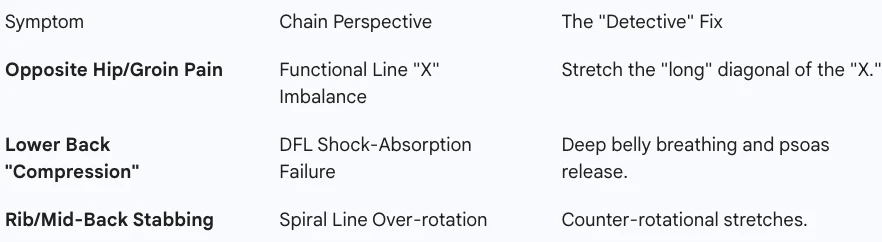
- The Result: This creates a massive diagonal “X” of tension. This is why many riders end up with a “groin pull” on one side and a “bicep/shoulder tear” on the opposite side. The body is trying to keep the arm attached to the torso while the horse tries to rip them apart.
2. The “Seat”: The Deep Front Line (DFL)
Survival on a bronc depends on your “adductor-to-core” connection.
- The Action: The DFL (inner thighs, pelvic floor, psoas) is what keeps the rider “on the horse.” If you rely only on your outer quads, you will bounce off.
- The Benefit: A strong DFL allows the rider to “hug” the horse with their deep core, absorbing the vertical “snap” of the buck through the spine rather than letting it rattle the brain.
- The Risk: The constant impact causes the DFL to “lock down.” This leads to the classic “cowboy walk”—hips that are permanently externally rotated and a pelvic floor that is constantly tight.
3. The “Whip”: The Superficial Front Line (SFL)
To stay in rhythm, the rider’s torso must move like a hinge.
- The Action: The SFL (abs and chest) is stretched to the limit as the rider “lays back” to stay with the horse’s jump, then snaps forward.
- The Result: This “whiplash” effect puts incredible pressure on the abdominal wall. It’s why “sports hernias” are so common in the rodeo world. The front “wetsuit” is being pulled apart by the force of the horse and then slammed shut by the rider’s own muscles.
4. The “Free Arm”: The Spiral Line (SL)
You have to keep one hand free and “mark out” the horse. This arm acts as a counterbalance.
- The Action: The Spiral Line is what allows the torso to twist and balance while the hips are locked onto the horse.
- The Result: The “driving” arm and the “free” arm create a massive spiral of tension across the mid-back. This is why riders often feel like their ribs are “out of place”—the Spiral Line is being wrung out like a wet towel with every jump.
The “Behind the Chutes” Recovery
Do these after a ride to “un-glue” the trauma of the impact.
- The “Saddle Lunge” (SFL/DFL): Put one foot way forward and sink your hips low, reaching your “rigging arm” toward the sky.
-
- Why: It unzips the front of the hip and the bicep/chest connection that was “clamped” during the ride.
- The “Pelvic Floor Drop” (DFL): Deep, wide-knee squats while focusing on breathing “into the basement” (the pelvic floor).
-
- Why: The impact of bronc riding causes the deep core to go into a defensive “guarding” state. You have to manually tell those muscles to let go.
- The “Opposite Shoulder Reach” (Functional Lines): Reach your “free arm” across your body and grab a post, then lean away.
-
- Why: It resets the diagonal “X” that was pulled taut during the ride.
Summary for the Bronc Rider