Barrel racing is a high-speed dance of lateral G-forces and asymmetric bracing. While the horse is doing the sprinting, the rider is managing incredible “centrifugal” force—the force that wants to throw you out of the saddle as you whip around a barrel at $30\text{ mph}$.
In this sport, the Lateral Line and the Spiral Line are doing the heavy lifting to keep you “centered” while the world tilts.
1. The “Pocket” Turn: The Lateral Line (LL)
As you head into a turn, you have to “stay with” the horse’s lean. This requires a massive amount of side-body stability.
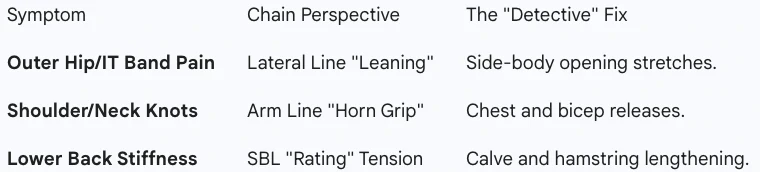
- The Action: The LL (the side-seam) on the “inside” of the turn must contract to keep your ribs from collapsing, while the “outside” LL stretches and stabilizes.
- The Result: This is why barrel racers often have “one-sided” hip pain. If you always turn the same way or have a “weak side,” your outer hip (glute medius) will burn out.
- The Risk: If the LL is “gluey,” you’ll “tip” in the saddle. Instead of staying centered over the horse’s spine, your weight shifts outward, which can actually slow the horse down or cause it to lose its footing.
2. The “Horn Grip”: The Arm Lines
Most barrel racers use one hand on the reins and one hand “bracing” or pulling on the saddle horn during the turn.
- The Action: This creates a massive Deep Front Arm Line (thumb side) tension. You are using the horn to “anchor” your upper body so the horse doesn’t pull you forward.
- The Result: This “tethers” your shoulder to your opposite hip through the core. It’s why you might feel a sharp pain in the back of your neck or your “reining shoulder” after a run—the Arm Line is pulling on the neck fascia to maintain your seat.
3. The “Sit-Down”: The Superficial Back Line (SBL)
When you reach the barrel, you “sit down” in the saddle to tell the horse to rate (slow down and turn).
- The Action: This requires a sudden, deep “sink” through the heels. The SBL (heels to brow) must be able to lengthen instantly.
- The Result: If your calves and hamstrings are tight, you won’t be able to “sink” properly. Instead of your weight going into your heels, it stays in your crotch/thighs, making you “bouncy” in the saddle right when you need to be the most stable.
4. The “Sprint Home”: The Functional Lines (FL)
Once you clear the third barrel, it’s a straight-line sprint to the timer.
- The Action: The Back Functional Line (diagonal from shoulder to opposite glute) fires to help you stay in rhythm with the horse’s gallop.
- The Result: You are essentially “pumping” with the horse. If this “X” is imbalanced, you’ll find yourself “rolling” in the saddle instead of moving in a straight, aerodynamic line with the horse.
The “Alleyway” Reset
Do these after your run to “un-wind” the turn tension.
- The “Horn-Hand” Release (Arm Lines): Take your “horn hand,” reach it behind your back, and look over the opposite shoulder.
-
- Why: It un-tethers the neck from the “white-knuckle” grip you had on the saddle horn.
- The “Stirrup Lunge” (SFL/LL): Stand with one foot on a fence rail or step and lean your hips forward while reaching the opposite arm over your head.
-
- Why: It opens the “side-seam” (Lateral Line) and the hip flexors that get crunched during the turns.
- The “Heel Drop” (SBL): Find a curb or the edge of your trailer and let your heels hang off the back.
-
- Why: It resets the “Back Line” so your lower back doesn’t stay “clamped” after the run.
Summary for the Barrel Racer