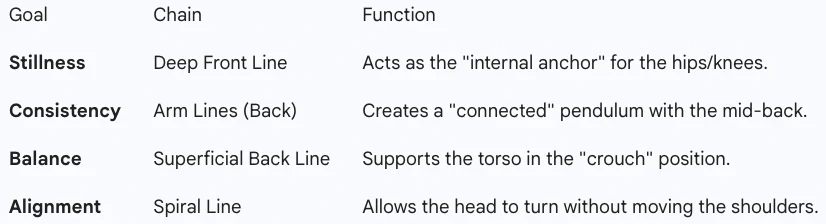
Putting is the polar opposite of the long-drive “trebuchet.” If the long drive is about explosive elasticity, putting is about absolute stillness and isolation. In putting, you are trying to “turn off” the powerful global chains (the “X” of the torso) so that the Arm Lines can move like a pendulum, independent of the rest of the body.
Here is the deep dive into the chains of the “Short Game.”
1. The “Anti-Twist”: The Deep Front Line (DFL)
The most common mistake in putting is “peeking” or moving the hips. To prevent this, you need your internal anchor.
- The Deep Dive: The DFL (the inner pillar) is your stabilizer. It runs from the arches of your feet, up the inner thighs, through the pelvic floor, and up the front of the spine.
- The Putting Secret: By “zipping up” the DFL, you create a solid foundation. This allows your lower body to be “quiet” (completely still) while your shoulders move.
- The Power Leak: If the DFL is “off,” your knees will wobble and your hips will rotate with your stroke, causing you to pull or push the putt.
2. The “Pendulum”: The Arm Lines
In a perfect putt, the hands and wrists do almost nothing. The movement is driven by the shoulders and the “V” shape formed by the arms.
- The Deep Dive: You are using the Superficial Back Arm Line (the tops of the shoulders and triceps) to maintain the structure of the pendulum.
- The Putting Secret: The goal is to “plug” your Arm Lines into your Latissimus Dorsi (mid-back). When the arms are connected to the large muscles of the back rather than the small muscles of the wrist, the stroke becomes incredibly consistent and repeatable.
- The Power Leak: If you “grip” the putter too tightly, you lock the Deep Front Arm Line (thumb side). This “tethers” your neck and makes your stroke “twitchy” or “yippy.”
3. The “Crouch Stability”: The Superficial Back Line (SBL)
Putting requires you to hang out in a forward-leaning “crouch” while staring at the line.
- The Deep Dive: The SBL (heels to brow) is holding the weight of your torso against gravity.
- The Putting Secret: If your hamstrings and calves are flexible, you can “sit” into the SBL comfortably. This provides a steady base for your eyes to track the ball.
- The Power Leak: If your SBL is tight (especially at the base of the skull), it creates “visual noise.” Tightness in the neck fascia can actually affect your depth perception and how you read the break on the green.
4. The “Eyes on the Line”: The Spiral Line (SL)
Even though you aren’t twisting like a long drive, the SL is involved because your head is turned 90 degrees to look at the hole.
- The Deep Dive: The Spiral Line manages the relationship between your head and your shoulders.
- The Putting Secret: You want a “neutral” SL that allows your head to rotate freely without pulling your lead shoulder forward.
- The Power Leak: If the SL is “glued” on your lead side, when you look toward the hole to check your line, your shoulder will follow your eyes. This opens your stance and leads to putts that miss to the left (for a righty).
The “Greens-Side” Precision Drills
Use these to “quiet” the body and sharpen the pendulum.
- The “Big Toe Anchor” (DFL): While practicing putts, focus on pressing your big toes firmly into the ground and “sucking up” your arches.
-
- Why: This “locks” the DFL and keeps your lower body from swaying.
- The “Arm-Pit” Glove Drill (Arm Lines): Tuck a glove or a small towel under each armpit and make your stroke without letting them fall.
-
- Why: This forces the Arm Lines to stay connected to the “Lats” and the torso, creating a true pendulum.
- The “Jaw Release” (DFL/SBL): Before you settle into your stance, open your mouth wide and relax your jaw.
-
- Why: As we saw with the wildlife photographer, focus leads to jaw clenching. A tight jaw “tethers” the neck and spine, making it harder for the shoulders to move smoothly.
Summary of Putting Mechanics