Stable hands are the unsung athletes of the equestrian world. While the riders get the “G-forces,” the stable hands deal with constant, heavy, asymmetric loads. Your day is a never-ending cycle of “mucking, lifting, and leading,” which creates a body that is incredibly strong but often “molded” into a permanent state of labor.
Here is how the chains react to the “Barn Chores” lifestyle.
1. The “Mucking Twist”: The Spiral Line (SL)
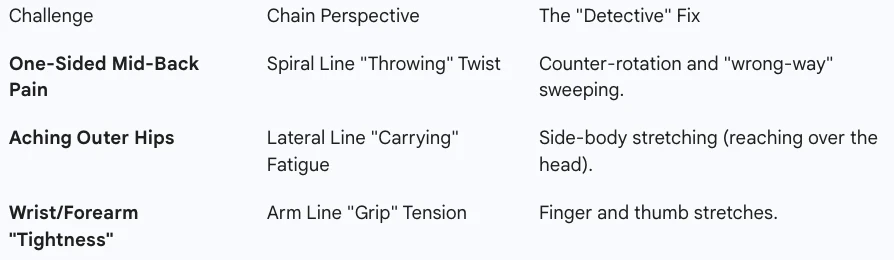
Shoveling manure and bedding is a repetitive rotational task. Most people have a “favorite” side to toss over their shoulder.
- The Culprit: The Spiral Line handles this “load and throw” motion.
- The Result: If you always toss to the left, your right hip and left shoulder are being “shortened” toward each other. Over time, your ribcage stays slightly rotated. This is why stable hands often have a “nagging” pain under one shoulder blade that never seems to go away.
2. The “Buckets and Bales” Carry: The Lateral Line (LL)
Carrying two heavy water buckets or a bale of hay creates a massive demand on your side-stability.
- The Culprit: The Lateral Line (the side-seam).
- The Result: To keep the buckets from hitting your legs, you have to “engage” your outer hips and obliques. If you carry a heavy load on just one side (like a bag of grain on one shoulder), the LL on that side “crunches” shut. This leads to that “lopsided” feeling where one hip feels higher than the other.
3. The “Leading a Puller”: The Arm Lines & Functional Lines
Leading a 1,200-pound horse that wants to move faster than you do puts a massive “traction” force on your arm.
- The Culprit: The Arm Lines (from fingers to chest) and the Back Functional Line (connecting that arm to the opposite leg).
- The Result: Your body uses the diagonal “X” of the Functional Line to anchor yourself against the horse. This is why your “leading arm” shoulder often feels pulled forward and down, and why you might feel a “tug” in your opposite lower back.
4. The “Pitchfork Grip”: The Deep Front Arm Line
Constant gripping of forks, brooms, and lead ropes keeps your hands in a “clamped” state.
- The Culprit: The Deep Front Arm Line (thumb side).
- The Result: This tension travels up the arm and “tethers” the front of your shoulder. It makes your chest feel tight and can actually make it harder to take a full, deep breath because the Arm Line is pulling on the ribs.
The “End of the Aisle” Reset
Do these after the morning chores to “un-mold” your body from the tools.
- The “Switch-Hitter” Shovel (Spiral Line): For the last 5 minutes of mucking or sweeping, force yourself to use your “non-dominant” side.
-
- Why: It provides a “functional reset” for the Spiral Line before the twist becomes permanent.
- The “Doorframe Hang” (Arm Lines): Grab a stable doorframe with both hands above your head and lean your chest forward.
-
- Why: It un-tethers the Arm Lines from your chest and lets your shoulders “drop” back into their sockets.
- The “Stirrup Lunge” (SFL/LL): Put one foot up on a mounting block or a tack trunk and lunge forward.
-
- Why: It unzips the hip flexors and the “side-seam” that get shortened from all the lifting and carrying.
Summary for the Stable Hand