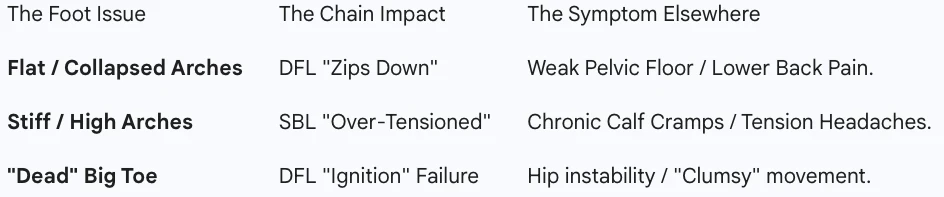
Your feet are the “roots” of every major chain (except the arms). We can look at how “flat feet” or “bunions” aren’t just foot issues, but a collapse of the Superficial Back Line or Deep Front Line starting from the ground up.
Since your feet are the only part of your body (usually) in contact with the ground, they are the “Master Input” for your fascial chains. In the world of tensegrity, the foot isn’t a solid block of bone; it’s a dynamic, spring-loaded tripod that initiates the “zip-up” for your entire frame.
If the foot collapses, the rest of the chains don’t just “lean”—they buckle.
Topic 3: The “Tensegrity” of the Foot
The foot is a masterpiece of fascial engineering. It has to be soft enough to mold to uneven ground (like a stall floor) and stiff enough to act as a lever for movement (like jumping).
1. The Tripod and the Arches
Your foot relies on three points of contact: the heel, the base of the big toe, and the base of the pinky toe.
- The Connection: These points are connected by three arches—the medial, lateral, and transverse.
- The Fascial Link: The Plantar Fascia acts like the “string on a bow.” It holds the tension that keeps the arches from flattening. When you step down, the fascia stretches and stores energy; when you lift off, it “snaps” back, giving you a free mechanical boost.
2. The Foot-Chain Handshake
Your foot is the starting line for the two most important “stability” chains:
- The Superficial Back Line (SBL): Starts under the toes and wraps around the heel. If your feet are “stiff,” it’s like having a tight anchor at the bottom of a long cable. This tension travels up the calf and hamstrings, eventually pulling on your lower back.
- The Deep Front Line (DFL): Starts at the inner arch. This is the “Pelvic Floor Remote Control.” When the arch is active and lifted, it sends a “tension signal” up the inner thigh to the pelvic floor and psoas.
3. The “Collapsed Arch” Domino Effect
When the medial arch collapses (flat feet), the “tensegrity” of the DFL is lost.
- The Chain Reaction: The foot rolls inward –> the knee collapses inward (valgus) –> the psoas loses its anchor –> the pelvic floor “shuts down” or over-tightens to compensate.
- The Result: You can do all the psoas stretches in the world, but if your foot is flat, the chain will “reset” to a tight, protective state the moment you stand up.
The “Foot-to-Core” Re-Wiring
If you are a rider or a stable hand, your “boot-bound” feet need this daily.
- The “Short Foot” Drill: Stand with feet flat. Without curling your toes, try to pull the ball of your foot toward your heel. You should see your arch lift.
-
- The Goal: Feel the “zip” happen in your inner thigh. This is you manually engaging the Deep Front Line.
- The Big Toe “Independence”: Can you lift just your big toe while keeping the other four on the ground?
-
- The Why: The big toe is the “on switch” for the DFL. If it’s stuck (due to tight boots or bunions), the rest of the internal pillar stays “off.”
- The Tennis Ball “Melt”: Roll a tennis ball or a “fascial ball” under the arch and the heel.
-
- The Why: This breaks up the “Fascial Fuzz” in the plantar fascia, allowing the SBL to slide freely again. It’s often the fastest way to relieve a “tight” feeling in your hamstrings.
Summary: The Foot “Detective”