There is a direct fascial link between your eye muscles and the tiny muscles at the base of your skull. We can explore how looking at a phone or tracking a horse actually “tethers” your entire Superficial Back Line.
Moving from the ground all the way to the top of the tower, we reach one of the most fascinating “shortcuts” in the human body. The Superficial Back Line (SBL) doesn’t just end at the back of your head—it wraps over your skull and attaches right at your brow.
At the very top of this chain sit the sub-occipitals, a cluster of tiny muscles that link your vision directly to your posture.
Topic 4: The “Eyes-to-Neck” Link (Sub-occipitals)
The sub-occipitals are the most densely innervated muscles in the body (meaning they have a massive number of nerve endings for their size). Their primary job is to tell the brain where the head is in space.
1. The “Steering Wheel” of the Body
There is a direct neurological reflex between your eye muscles and your sub-occipitals.
- The Action: Without moving your head, look as far to the right as you can. You will feel a tiny “thump” or contraction at the base of your skull on the right side.
- The Benefit: Your eyes “steer” your body. If you see a “spook” in the corner of the arena or a tool falling in the barn, your eyes move first, the sub-occipitals fire second, and the rest of the SBL prepares the body to move.
2. The “Visual Anchor” Problem
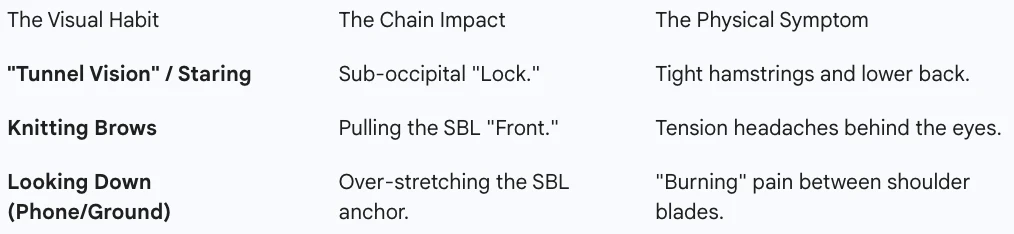
In the modern world (and even in technical riding), we spend a lot of time with “fixed vision”—staring at a phone, a screen, or even staring intently at a horse’s ears.
- The Lock: When your eyes lock on a fixed point for too long, the sub-occipitals “freeze” to keep the head perfectly still.
- The Chain Reaction: Because the sub-occipitals are the anchor for the Superficial Back Line, their tension travels down. This is why staring at a screen for three hours makes your hamstrings feel tight. You haven’t used your legs, but the “anchor” at the top of the cable is pulling the whole line taut.
3. The “Concentration Headache”
The SBL continues from the base of the skull, over the top of the head (the epicranial aponeurosis), and ends at the eyebrows.
- The Result: When you are stressed or concentrating hard, you knit your brows and tighten your eyes. This pulls on the “front” end of the SBL, which in turn tightens the sub-occipitals.
- The Feeling: This is that classic “vise-grip” headache that feels like a tight band around your forehead.
The “Visual Reset” for the Chains
If you’ve been doing “fine” work (cleaning tack, reading, or precision riding), do this to un-tether your back.
- The “Horizon Scan”: Stand up and look as far away as possible. Let your eyes “soften” (peripheral vision). Slowly rotate your head left and right while keeping your eyes on the horizon.
-
- The Why: This breaks the “fixed vision” lock and tells the sub-occipitals they can stop bracing.
- The “Eye-Press” Release: Close your eyes and gently place your palms over them (don’t press on the eyeballs, just the sockets). Breathe deeply.
-
- The Why: This “darkness” reset calms the optic nerve, which immediately allows the sub-occipitals to drop their tone.
- The Sub-occipital “Nod”: Tuck your chin slightly (making a “double chin”) and imagine the back of your head is being pulled up by a string.
-
- The Why: This creates space at the base of the skull, “de-compressing” the start of the SBL.
Summary: The Eye-Neck Detective
Softening your gaze could actually loosen your calves!