When we talk about the “anxiety effect” on the body, we are looking at a state of chronic bracing. Anxiety isn’t just a feeling in your head; it is a physiological command that tells your fascia to “get ready for impact.”
Because anxiety is often a long-term, low-grade “alarm,” it creates a specific pattern of tension that can eventually feel like your natural posture.
1. The “Internal Squeeze” (Deep Front Line)
The Deep Front Line (DFL) is the most sensitive to anxiety. It contains your “core” stabilizers, including the diaphragm and the psoas.1
- The Effect: Anxiety causes you to take short, shallow “chest breaths.”2 This keeps the diaphragm in a high, tight position. Because the diaphragm is fascially connected to the psoas (the deep hip flexor), your hips “tighten” in sympathy.3+1
- The Result: You feel a constant “pit” in your stomach or a sense of “heaviness” in your hips. Long-term, this leads to lower back pain because your “internal pillar” is always squeezed shut.
2. The “Startle Reflex” (Superficial Front Line)
If anxiety makes the DFL squeeze, it makes the Superficial Front Line (SFL) “shield.”
- The Effect: This is the “crouch” of protection. Your shoulders roll forward to protect your heart, and your neck pulls your head forward to protect your throat.
- The Result: This is often called “Tech Neck,” but in this case, it’s “Anxiety Neck.” The front of your body feels short and tight, making it physically difficult to stand up straight and feel “confident.”
3. The “Visual Scan” (Superficial Back Line)
When you are anxious, your brain is constantly scanning for threats. This requires a high level of activity in the sub-occipital muscles (at the very top of your neck).
- The Effect: These muscles are the “anchor” for the Superficial Back Line (SBL). When they tighten, they pull on the fascia that runs over your skull and down to your heels.
- The Result: This is the primary cause of tension headaches. The “band” of pain around your forehead is actually the SBL pulling tight from your heels all the way to your eyebrows.
How to Break the Anxiety Loop
Because the brain and fascia are a two-way street, you can use the “reset” to calm the mind. If you manually “un-loop” the physical tension, the brain often follows suit.
- The “Vagus Flush”: Gently massage the area right behind your earlobes and down the side of your neck. This targets the Arm Lines and neck fascia that “tether” your stress response.
- The “Psoas Release”: Sit on the floor with your back against a wall and your feet together (Butterfly stretch). Breathe into your low belly. This forces the DFL to “unlock” the hips.
- The “Horizon Scan”: Instead of looking down at your phone or the floor, look at the furthest point on the horizon and let your eyes soften. This releases the “visual scan” tension in the SBL.
Summary: The Anxiety Mapping
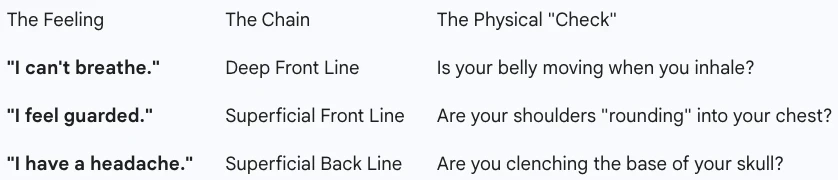
Does that explain why anxiety feels so “exhausting” for the whole body? It’s because your chains are working overtime to protect you.