Fascia has 6x more sensory nerves than muscle. We can look at how the chains act as a “GPS system” for your brain, and why “clumsiness” is often just a “noisy” fascial communication.
Now that we’ve looked at the “hardware” (the feet and the neck), let’s look at the “software.”
Proprioception is your body’s ability to sense its own position in space without looking. While we used to think this was a “muscle” sense, we now know it is almost entirely a fascial sense. Your fascia contains about six times more sensory nerve endings than your muscles.
Topic 5: Proprioception (The Fascia as a Sensory Organ)
Your fascia is like a high-tech “liquid crystal” bodysuit. It is constantly sending data to your brain about tension, pressure, and vibration. This is how a rider knows exactly where their leg is against the horse’s side without looking down.
1. The “GPS” Mesh
Every time you move, the collagen fibers in your chains (like the Spiral Line or Lateral Line) stretch and slide. This movement triggers “mechanoreceptors” (tiny sensors) embedded in the fascia.
- The Action: Your brain maps these signals to create an internal 3D image of your body.
- The “Detective” Fail: When fascia gets “glued” or dehydrated (the “fuzz” we talked about), the sensors can’t fire properly. Your “GPS” signal becomes “noisy” or laggy. This is why you might trip over your own feet or feel “clumsy.”
2. The “Ruffini” and “Pacini” Sensors
Fascia has different sensors for different “data”:
- Pacini Sensors: These respond to vibration and rapid changes in pressure. They are dense in the feet and hands. (Think: feeling the “beat” of the horse’s gallop through the stirrups).
- Ruffini Sensors: These respond to slow, lateral stretching. They are the key to relaxation. When you do a slow, melting stretch, you are “tuning” the Ruffini sensors to lower your nervous system’s tone.
3. “Body Blindness”
If an area of your body has been injured or held still for a long time (like a lower back “locked” by stress), the brain eventually “mutes” the signal from that area to save energy.
- The Result: You lose the ability to move that specific segment independently. This “body blindness” is why some people can’t “wiggle” their toes or move their shoulder blades without moving their whole torso.
How to “Re-Map” Your Fascial GPS
Use these “sensory” drills to sharpen your movement software.
- The “Skin Brush”: Before a workout or riding, use your hands to briskly “brush” your skin all over your legs and arms.
-
- The Why: This wakes up the superficial sensors and tells the brain, “Hey, this part of the body is about to move!” It sharpens your proprioception instantly.
- Slow-Motion “Ghost” Movements: Close your eyes and move your arm in a circle as slowly as possible—so slow that you can feel every “glitch” or “jump” in the movement.
-
- The Why: This forces the brain to pay attention to the “noisy” parts of the chain, clearing the “body blindness.”
- Balance on Uneven Surfaces: Stand on one leg on a folded towel or a foam pad while doing a simple task like brushing your teeth.
-
- The Why: This forces the sensors in the Lateral Line and Deep Front Line to fire rapidly to keep you upright, “re-booting” the GPS.
Summary: The Proprioception Detective
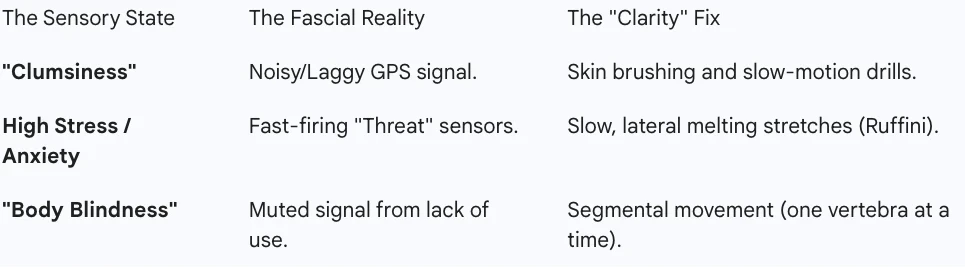
“Coordination” is not just talent; it’s how clear your fascial signal is!