Your organs are wrapped in the same “wetsuit” as your muscles. We can look at how a “tight stomach” (digestion) or “heavy lungs” (post-illness) can physically pull your posture into a slouch via the Deep Front Line.
This is where the “wetsuit” analogy gets really interesting. Your organs (the viscera) aren’t just floating around in your torso; they are tucked into “envelopes” of fascia and suspended from your spine, diaphragm, and pelvis by fascial “ligaments.”
If your muscles are the outer fabric of the suit, your organs are the inner lining. If the lining gets snagged, the whole suit twists.
Topic 6: Visceral Manipulation (Fascia of the Organs)
We often think of posture as a skeletal or muscular issue, but your internal organs have a massive “pull” on your frame. They are the “cargo” inside the Deep Front Line (DFL).
1. The “Balloon” Support
Your organs provide internal “hydrostatic” pressure. When they are healthy and moving well, they act like an inflated balloon that helps support your spine from the inside.
- The Snag: If an organ becomes “congested” or the fascia around it tightens (due to inflammation, old surgeries, or even chronic stress), it becomes like a “weighted anchor.”
- The Result: A tight liver (on your right side) can literally pull your right shoulder forward and down, creating a “twist” in your Spiral Line that no amount of shoulder stretching will fix.
2. The Diaphragm: The Great Connector
The diaphragm is the “ceiling” of the organ cavity. Most of your major organs (liver, stomach, spleen) are fascially attached to the underside of the diaphragm.
- The Action: Every time you take a deep breath, your diaphragm moves down, “massaging” your organs.
- The Lock: If you are a “chest breather” (common in anxiety), your diaphragm doesn’t move. Your organs lose their daily “massage,” the fascia around them becomes “sticky” (fuzz), and they start to “tether” your mid-back.
3. Digestion and the Psoas
The kidneys and the colon sit directly on top of the psoas muscle.
- The Link: If you have chronic digestive inflammation or “gut” tension, the fascia of the intestines can “leak” that tension into the psoas.
- The Result: This is why “gut issues” almost always come with “lower back pain.” Your brain can’t distinguish between a “crampy colon” and a “tight psoas” because they share the same fascial neighborhood.
The “Internal” Reset
Try this to “un-snag” the inner lining of your suit.
- The “Visceral Lift”: Stand up and place your hands at the very bottom of your ribcage. Take a deep breath in, and as you exhale, gently lift your hands upward (as if you’re trying to tuck your organs up under your ribs).
-
- The Why: This manually “de-compresses” the organs and slacks the fascial ligaments that hang from the diaphragm.
- The “Clockwise Rub”: Using flat palms, massage your abdomen in a slow, clockwise circle.
-
- The Why: This follows the path of the large intestine. It helps break up “fuzz” in the visceral fascia, which can immediately “release” tension in the Deep Front Line and your hips.
- The “Swaying Willow”: Stand and slowly sway your hips in a figure-eight pattern.
-
- The Why: This “sloshes” the internal fluid and ensures the organs aren’t “glued” to the back wall of your abdominal cavity.
Summary: The Visceral Detective
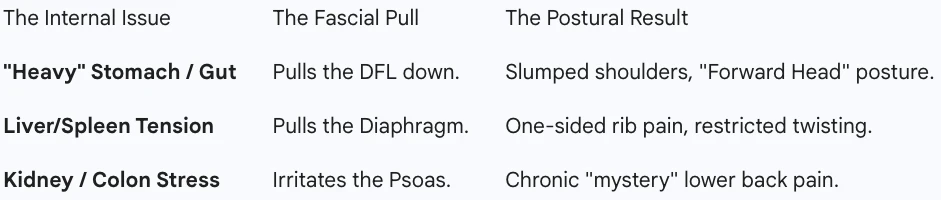
Your “slouch” could be coming from your stomach rather than your spine!