Skiing is a masterpiece of asymmetrical symmetry. Unlike a snowboarder who is locked into one piece of wood, a skier has two independent “outriggers.” This allows for incredible agility, but it also creates a unique fascial demand: your chains must be able to “slide” past each other.
In skiing, the legs are independent, but the core must remain a solid “quiet” center.
1. The “Piston”: The Deep Front Line (DFL)
In skiing, your legs act like pistons, absorbing every bump and dip in the terrain.
- The Action: The DFL (the inner pillar) is what connects your arches to your deep core. This is your “shock absorption” system.
- The Benefit: When the DFL is active, your legs can move up and down rapidly while your upper body remains perfectly still and level.
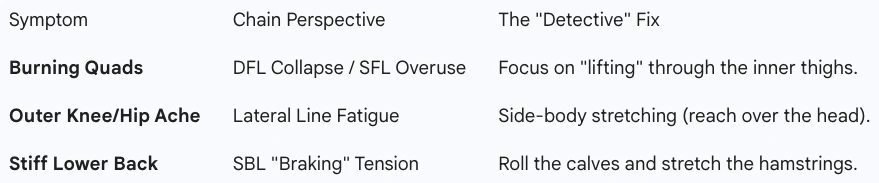
- The Risk: If the DFL “shuts down,” you’ll start “quad-dominating.” Your big outer thigh muscles (SFL) will burn out in minutes, and the impact of the snow will travel directly into your lower back.
2. The “Angulation”: The Lateral Line (LL)
To make a sharp turn, a skier has to “angulate”—tipping the skis onto their edges while keeping the torso vertical.
- The Action: The Lateral Line on the “downhill” side of the turn must contract powerfully to hold that edge, while the “uphill” side stays long.
- The Result: This is why skiers often feel “side-body” soreness. You are essentially doing thousands of high-speed “side-planks” as you move down the mountain.
- The Risk: If the LL is tight, you can’t get your skis on a high edge. You’ll end up “skidding” your turns rather than “carving” them.
3. The “Platform”: The Superficial Back Line (SBL)
Ski boots are designed to tilt you forward. This puts the SBL under a constant, eccentric stretch.
- The Action: Your calves and hamstrings are working to “brake” your body as you lean into the front of the boots.
- The Result: This creates massive tension in the SBL. Because the ankle is locked in a plastic shell, the “hinge” of the body moves up to the knee and the hip.
- The Risk: This is a major factor in ACL injuries. If the SBL (specifically the hamstrings) is too tight or fatigued, it can’t help protect the knee joint during a twist or a fall.
4. The “Pole Plant”: The Arm Lines & Functional Lines
Skiing isn’t just a leg sport; your upper body provides the rhythm and the “swing.”
- The Action: Every pole plant engages the Front Functional Line (connecting the arm to the opposite hip).
- The Benefit: This creates a diagonal “anchor” that helps you initiate the next turn.
- The Risk: If you “grip” the poles too hard (especially in the cold), you lock your Arm Lines, which hitches your shoulders up. This is why many skiers have a “stiff neck” after a day of powder—they were literally “carrying” their poles with their neck muscles.
The “Lodge” Recovery Routine
Do these while you’re taking your boots off to “reset” the chains for tomorrow.
- The “Boot-Free” Toe Spread (DFL): After hours in tight boots, spend a minute wiggling your toes and trying to lift your arches.
-
- Why: It “re-hydrates” the bottom of the Deep Front Line, which is essential for balance and shock absorption.
- The “Seated Cross-Leg Lean” (LL/SBL): Sit on a bench, cross one ankle over the opposite knee, and lean forward with a flat back.
-
- Why: It releases the outer hip (Lateral Line) and the deep glutes that were working to stabilize your “pistons” all day.
- The “Shoulder Blade Drop” (Arm Lines): Reach your arms wide and rotate your palms to face the ceiling, pulling your shoulder blades down your back.
-
- Why: It un-tethers the Arm Lines from the neck, releasing the “pole-plant” tension.
Summary for the Skier