Show jumping is a game of dynamic suspension. Unlike the vertical stillness of dressage, a jumper’s body has to act like a high-performance shock absorber. You are constantly shifting between the “two-point” stance (hovering over the saddle) and the “full seat,” all while managing the massive kinetic energy of a horse launching over an obstacle.
In jumping, the Superficial Back Line and the Functional Lines are your primary stabilizers.
1. The “Two-Point” Hover: The Superficial Back Line (SBL)
When you are up in your stirrups, your heels are down and your torso is leaned forward. This places the entire back of your body under a massive “eccentric” load—meaning the muscles are working hard while they are stretched long.
- The Action: The SBL (heels to brow) acts like a suspension cable. Your calves, hamstrings, and lower back are the “springs” holding you out of the saddle.
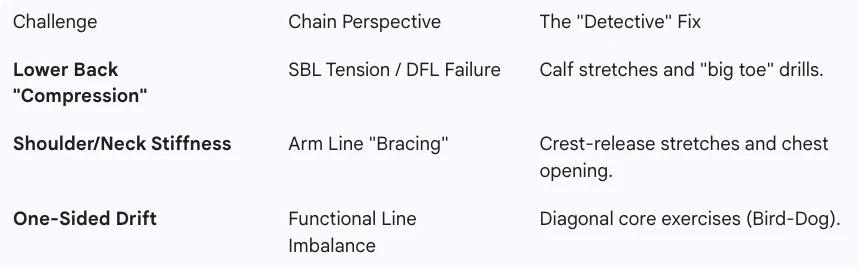
- The Result: This is why jumpers often have “iron calves” but also chronic lower back fatigue. If the SBL is too tight, you’ll lose that “spring” and become “heavy” in the saddle, which can interfere with the horse’s ability to clear the back rail.
2. The “Release”: The Arm Lines
At the peak of the jump, you perform the “crest release,” reaching your hands forward toward the horse’s ears to give them the freedom to use their neck.
- The Action: This requires the Deep Back Arm Line (triceps and shoulders) to extend fully while maintaining a soft contact.
- The Risk: If your chest (Front Arm Line) is tight, you won’t be able to follow the horse’s mouth forward smoothly. You’ll end up “catching” the horse in the mouth or “snapping” your upper body back too early, which unbalances the landing.
3. The “Landing Brace”: The Functional Lines (FL)
Landing after a 4-foot jump sends a massive “jolt” through your frame. To stay in the middle of the horse, you need the “X” of your core to fire.
- The Action: The Back Functional Line (shoulder to opposite hip) stabilizes your torso against the impact.
- The Benefit: A strong FL prevents you from “flopping” forward onto the horse’s neck or falling behind the motion upon landing.
- The Risk: If you always turn or look to one side after a jump, you’ll develop a “dominant” diagonal. This makes the horse feel like you’re “heavier” on one side, which can cause them to drift or refuse at the next fence.
4. The “Shock Absorber”: The Deep Front Line (DFL)
The DFL is what allows you to “stay soft” while the horse is explosive.
- The Action: The DFL (inner thighs to diaphragm) acts as the internal hydraulic system.
- The Benefit: When you land, if your DFL is active, the impact is absorbed by your deep core and “zipped” up toward your head.
- The Risk: If you “stiffen” your legs (relying only on the outer quads), the energy of the landing has nowhere to go but your knee joints and spinal discs. This is the source of “jumper’s back”—it’s a failure of the internal shock absorption.
The “Course-Walk” Reset
Do these after a jumping session to “re-set” your suspension system.
- The “Stirrup” Calf Drop (SBL): Stand on the edge of a mounting block or a step and let your heels drop low.
-
- Why: It “unzips” the massive tension built up in the Back Line from the two-point stance.
- The “Reach and Round” (Arm Lines/Back Line): Reach your arms far forward (like a crest release), interlace your fingers, and round your upper back while tucking your chin.
-
- Why: It reverses the “bracing” tension in the shoulders and opens the space between the shoulder blades.
- The “Wall-Sit with Big Toe Press” (DFL): Lean your back against a wall in a shallow squat and focus on pressing your big toes down while lifting your inner arches.
-
- Why: It “re-boots” the Deep Front Line so your body remembers how to absorb impact correctly.
Summary for the Show Jumper