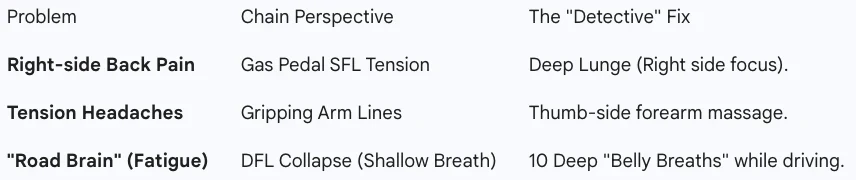
Driving for long distances is a unique physical challenge because it combines sustained vibration, prolonged compression, and a “locked-long” posture. While a desk worker can at least stand up and walk to a water cooler, a trucker is vibrating in a seat for hours, which causes the fascia to “thixotropically” set—meaning it literally becomes more solid and less fluid.
Here is how the chains react to the “Driver’s Seat” mold.
1. The “Gas Pedal” Leg: The Superficial Front Line (SFL)
Your “driving leg” is in a constant state of micro-tension to manage the pedals.
- The Culprit: The SFL (quads and hip flexors) on the right side is never truly at rest. It stays “on” to hover over the gas or brake.
- The Result: This pulls the right side of the pelvis forward and down. When you finally step out of the cab, you might feel like you’re “limping” or that your right lower back is “pinched.” It’s because the front “wetsuit” is too short.
2. The “Steering Wheel Reach”: The Arm Lines
Holding a steering wheel at “10 and 2” or “9 and 3” for hours tethers your upper body.
- The Culprit: The Deep Front Arm Line (thumb side) is gripped, and the Superficial Front Arm Line (chest) is shortened.
- The Result: This “collapses” the chest. Because the Arm Lines are connected to the neck, the tension travels upward, causing that deep ache at the base of the skull. This is often why drivers feel “eye strain” or tension headaches—it’s actually coming from the grip on the wheel.
3. The “Vibration Fatigue”: The Deep Front Line (DFL)
The constant vibration of the road travels through the seat and directly into your spine.
- The Culprit: The DFL (your inner pillar) is supposed to act as a shock absorber. But if you “slump,” the DFL goes to sleep.
- The Result: Without the “inner lift” of the DFL, the vibration is absorbed by your spinal discs instead of your muscles. This leads to the classic “Trucker’s Back” and general fatigue. Shallow breathing (because the diaphragm is squashed) also reduces oxygen to the brain, contributing to road fatigue.
4. The “Wallet Hip”: The Lateral Line (LL)
Many drivers sit with a wallet in their back pocket, or they lean their left arm on the window sill.
- The Culprit: This creates a massive imbalance in the Lateral Line. One side of the ribs is “crunched” toward the hip, while the other is over-stretched.
- The Result: The “side-seams” of the body become asymmetrical. This twists the Spiral Line, making it feel like your “back is out” when you try to turn and look behind the trailer.
The “Truck Stop” 3-Minute Reset
Do these every time you pull over for fuel or a break to “un-mold” your body.
1. The “Bumper Lunge” (SFL)
- The Move: Put one foot up on the step or bumper of the truck. Squeeze your glute and push your hips forward. Reach the same-side arm way up to the sky.
- Why: It “unzips” the front of the hip and the chest simultaneously.
2. The “Doorframe Twist” (Spiral Line)
- The Move: Stand in the cab door. Grab the frame with both hands and gently rotate your body away.
- Why: It wrings out the spine and releases the tension from hours of sitting square.
3. The “Steering Wheel Chest Opener” (Arm Lines)
- The Move: Before getting out, grab the back of your seat or the steering wheel (if safe) and pull your chest forward while rolling your shoulders back.
- Why: It opens the “Front Arm Lines” and gives your lungs room to breathe.
Summary for the Driver