Hockey is a game of explosive propulsion and constant “crouching.” While figure skating is about vertical rotation and “lift,” hockey is about horizontal power and a “low center of gravity.”
Because hockey players live in a “forward-flexed” position (the hockey stance), their anatomy chains often become biased toward the front of the body, creating a very specific “Powerhouse” profile.
1. The “Stride”: The Functional Lines (FL)
Every time you take a stride, you are using the diagonal connection between your pushing leg and your opposite arm.
- The Action: The Front Functional Line connects your pec (chest) to the opposite hip. When you “push off” with your right leg, your left arm swings forward to balance the torque.
- The Benefit: This “X” allows you to transfer power from the ice up through your core and into your stick for a slap shot.
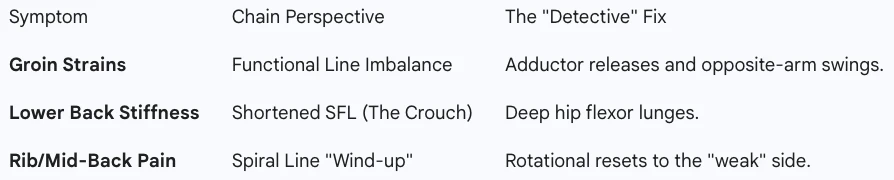
- The Risk: Because the stride is an “out and back” motion, the inner thighs (adductors) are under massive strain. If the “X” isn’t balanced, the force “leaks” into the groin, leading to the classic “Hockey Groin” pull.
2. The “Stance”: The Superficial Front Line (SFL)
The “Hockey Crouch” is held for almost the entire game.
- The Action: The SFL (quads, hip flexors, abs) is kept in a shortened, “loaded” state.
- The Result: This creates the “Hockey Butt” posture—where the pelvis tilts forward because the hip flexors are so tight.
- The Risk: A shortened SFL “tugs” on the lower back. When a player tries to stand up straight after a long shift, the tight front “wetsuit” prevents the spine from finding neutral, leading to chronic lower back stiffness.
3. The “Power Pillar”: The Deep Front Line (DFL)
In hockey, you are constantly being hit or leaned on. To stay on your feet, you need “Internal Stability.”
- The Action: The DFL (the inner pillar) is what keeps your core solid when someone tries to check you off the puck.
- The Benefit: A strong DFL allows you to “absorb” a hit and stay balanced. It also connects the arches of the feet to the core, which is vital since skates (like figure skates) tend to “turn off” the foot muscles.
- The Risk: If a player “over-trains” their outer abs (six-pack) and ignores the DFL, they become “brittle.” They might look strong, but they lose their “buoyancy” on the ice and are more prone to sports hernias.
4. The “Slap Shot”: The Spiral Line (SL)
Winding up for a shot is the ultimate “loading” of the Spiral Line.
- The Action: You rotate your torso away from the target, “winding up” the double helix of the SL, and then release it like a spring.
- The Result: Most players always shoot from the same side (Left or Right). This means one side of the SL is incredibly strong and thick, while the other is “fuzzy.”
- The Risk: This creates a “permanent twist” in the ribcage. Over time, this asymmetry can cause the ribs to pull on the mid-back, leading to that “stabbing” pain under the shoulder blade.
The “Locker Room” Recovery Routine
Do these before you head to the showers to “unlock” the hockey stance.
- The “Couch Stretch” (SFL): Put one knee on the floor (or a bench) and your foot up against the wall behind you. Squeeze your glute and stand tall.
-
- Why: It “unzips” the hip flexors that have been crunched in the hockey stance all game.
- The “Adductor Rock-Back” (DFL/Functional Lines): Get on all fours, extend one leg out to the side, and gently rock your hips back toward your heel.
-
- Why: It releases the inner thigh (groin) and resets the “X” of the functional lines.
- The “Opposite Shot” Swing (Spiral Line): Even if you’re a righty, take a few “ghost swings” as if you were a left-handed shooter.
-
- Why: It provides counter-tension to the Spiral Line, preventing your torso from staying “twisted” to one side.
Summary for the Hockey Player