Figure skating is the pinnacle of “Tensegrity in Motion.” It requires the explosive power of a sprinter, the flexibility of a gymnast, and the “quiet” grace of a ballerina—all while balancing on a steel blade just millimeters thick.
In figure skating, the Spiral Line and Deep Front Line are the absolute governors of performance.
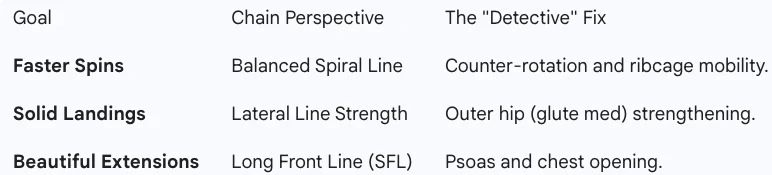
1. The “Centrifuge”: The Spiral Line (SL)
Whether it’s a triple axel or a tight scratch spin, figure skating is a sport of rapid rotation.
- The Action: The Spiral Line wraps around your body like a double helix. To pull into a jump or spin, you “wind up” this line. The tighter you can pull your arms and legs to your midline, the faster you rotate.
- The Benefit: A fluid, responsive SL allows for “snappy” rotations. If the SL is “glued,” your air position will be loose, and your rotations will be slow.
- The Risk: Skaters always spin in one direction (usually counter-clockwise). This creates a massive imbalance where one side of the SL is “locked-short” and the other is “over-stretched.” This is why skaters often have one hip that feels “tighter” than the other.
2. The “Blade Connection”: The Deep Front Line (DFL)
Maintaining a deep edge or a rock-solid landing requires an “internal anchor.”
- The Action: The DFL connects the arches of the feet to the pelvic floor and deep core.
- The Benefit: When you land a jump, the DFL acts as the internal stabilizer that keeps your “center” from collapsing. It’s what gives a skater that “lifted” look even during high-impact moves.
- The Risk: Skates are incredibly stiff and restrictive. This “locks” the bottom of the DFL. If a skater doesn’t actively work on foot and toe mobility, the DFL “shuts down,” leading to knee instability and a loss of that “internal lift.”
3. The “Landing Edge”: The Lateral Line (LL)
The “checked” landing position is a masterclass in Lateral Line stability.
- The Action: As you land on one foot, the LL on the landing leg must fire instantly to prevent the hip from “dropping” or the knee from buckling inward.
- The Benefit: A strong LL ensures a clean, flowing exit from a jump.
- The Risk: Constant high-impact landings on the same leg can cause the LL (specifically the IT band and glute medius) to become “thickened” and tight. This can lead to “Snapping Hip” syndrome or chronic outer-knee pain.
4. The “Long Line”: The Superficial Front Line (SFL)
Figure skating aesthetics demand a “long, beautiful line,” especially in spirals and extensions.
- The Action: The SFL (from the toes to the neck) must be able to lengthen fully.
- The Benefit: A long SFL allows for a high “arabesque” position and an open chest.
- The Risk: The “crouch” position used for crossovers and generating speed can make the hip flexors (part of the SFL) very tight. If the front “wetsuit” is too short, the skater will “break” at the waist during extensions, ruining the aesthetic line and straining the lower back.
The “Off-Ice” Recovery Routine
Do these after your session to “un-wind” from the stiffness of the skates.
- The “Counter-Spin” Twist (Spiral Line): If you always spin to the left, spend two minutes doing very slow, mindful twists to the right.
-
- Why: It helps “re-center” the Spiral Line and prevents your spine from staying “pre-twisted.”
- The “Big Toe Awakening” (DFL): After taking off your skates, try to pick up a small towel or marbles with your toes.
-
- Why: It “re-hydrates” the bottom of the Deep Front Line after being locked in a rigid boot.
- The “Lunge and Side-Reach” (LL/SFL): Take a lunge and reach the arm on the “back-leg” side up and over toward the opposite side.
-
- Why: It unzips the hip flexors and the “side-seam” that get crunched during crossovers and landings.
Summary for the Figure Skater