Yoga and Pilates are the ultimate “Chain Awareness” practices. While most sports use the chains for a specific goal (throwing a ball, pedaling a bike), Yoga and Pilates are about refining the tension within the chains themselves.
In these practices, you aren’t just moving; you are “tuning” the instrument.
1. The “Elasticity”: Yoga and the SBL/SFL
Yoga is often a constant dialogue between the Superficial Back Line (SBL) and the Superficial Front Line (SFL).
- The Action: In a pose like Downward Dog, you are challenging the entire length of the SBL. In a Cobra or Upward Dog, you are lengthening the SFL.
- The Insight: If you feel a “block” in your Downward Dog, it’s rarely just your hamstrings. Because it’s a chain, a tight scalp or tight calves (the anchors of the SBL) can be what’s actually stopping your heels from touching the floor.
- The Benefit: By moving through these “Sun Salutations,” you are essentially “flossing” the two major longitudinal cables of the body.
2. The “Powerhouse”: Pilates and the Deep Front Line (DFL)
Pilates is arguably the most DFL-focused movement system in the world. Joseph Pilates called it the “Powerhouse,” but in anatomy terms, it’s the Deep Front Line.
- The Action: Moves like “The Hundred” or “Leg Circles” require you to stabilize your spine using the deep stabilizers (psoas, diaphragm, pelvic floor) while the outer limbs move.
- The Insight: If you “grip” your six-pack (SFL) too hard during Pilates, you actually shut down the DFL. This leads to neck strain because the “Inner Pillar” isn’t supporting the weight of your head.
- The Benefit: True Pilates strength feels “hollow” and “lifted” rather than “crunched” and “heavy.”
3. The “Balance”: The Lateral Line (LL)
In standing balances like Tree Pose (Vrksasana) or Pilates Side Kicks, the Lateral Line is the hero.
- The Action: The LL on the standing leg must “zip up” to prevent the hip from kicking out.
- The Insight: If you find yourself wobbling, check your “Stirrup” (the connection between the peroneal muscles on the outside of the leg and the tibialis anterior). If the foot-to-hip connection is “fuzzy,” the balance fails.
- The Benefit: A strong Lateral Line creates “unshakeable” stability that translates to better gait and posture in daily life.
4. The “Wring Out”: The Spiral Line (SL)
Twisting poses (like Revolved Triangle) are the diagnostic tool for the Spiral Line.
- The Action: You are rotating the ribcage against the pelvis, which stretches the “Double Helix” of the SL.
- The Insight: Many people “cheat” twists by pulling with their arms. A true Spiral Line twist comes from the core. If your SL is “glued,” you’ll feel a pinch in your lower back instead of a smooth rotation through your mid-back.
- The Benefit: This “wrings out” the internal organs and restores the “X” coordination needed for walking and running.
Common “Yoga/Pilates” Troubleshooting
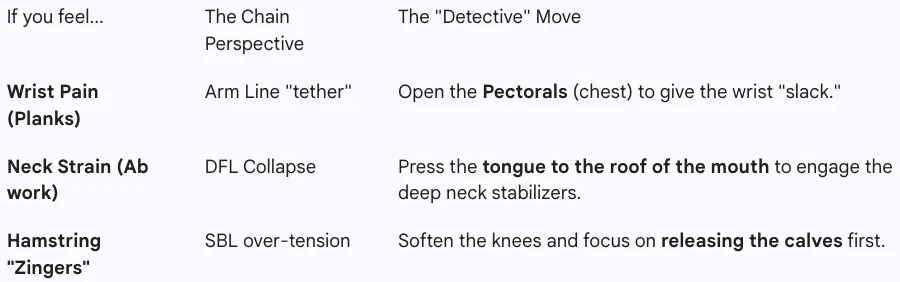
The “Mat-Side” Reset
If you feel “stuck” in your practice, try this:
- The “Big Toe Press”: In any standing pose, press your big toe down firmly.
-
- Why: This “plugs in” the Deep Front Line, instantly making your core feel more stable.
- The “Ear-to-Shoulder” Breathe: While in a twist, imagine breathing into the space between your ear and your shoulder.
-
- Why: It releases the top of the Spiral Line, allowing for a deeper rotation without straining the neck.