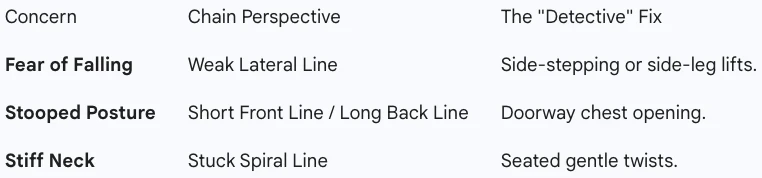
For the aging adult, maintaining these anatomy chains is about more than fitness—it’s about independence, balance, and breathing.
As we age, our fascia tends to lose water and become “brittle” or “glued.” This process (sometimes called “drying out”) is what creates the feeling of stiffness in the morning. By focusing on the chains, we can keep the body “juicy” and prevent the “stoop” that often comes with time.
1. The “Anti-Gravity” Cable: The Superficial Back Line (SBL)
The SBL is what keeps us upright against the constant pull of gravity.
- The Issue: Over time, the SBL often becomes “locked-long” in the upper back (the hunch) and “locked-short” in the calves and hamstrings.
- The Risk: Tight calves are a major cause of trips and falls. If your ankles can’t flex properly because the SBL is tight, your toes are more likely to catch on a rug or a curb.
- The Goal: Keep the “Master Cable” long from the heels to the eyebrows to maintain a tall, confident posture.
2. The “Balance Beam”: The Lateral Line (LL)
Falls often happen sideways. The Lateral Line is your “side-to-side” stabilizer.
- The Issue: We rarely move sideways in daily life (we mostly walk forward). This causes the Lateral Line to become “fuzzy” or weak.
- The Risk: If the LL isn’t firing, the hips become unstable. This leads to “wobbling” while walking, which the brain perceives as a threat, causing the person to take smaller, more tentative steps.
- The Goal: Strengthen the “side-seams” to create a wide, stable base of support.
3. The “Vitality Pillar”: The Deep Front Line (DFL)
This is arguably the most important chain for aging gracefully. It houses the diaphragm (breathing) and the pelvic floor.
- The Issue: As movement decreases, the DFL “collapses.” Breathing becomes shallow and moved into the neck muscles, and the “internal lift” that supports the spine vanishes.
- The Risk: Shallow breathing leads to lower oxygen levels and higher anxiety. A weak DFL also contributes to bladder control issues and lower back instability.
- The Goal: Reconnect the breath to the deep core to maintain “internal buoyancy.”
4. The “Safety Check”: The Spiral Line (SL)
The Spiral Line allows you to look behind you (like when backing up a car or hearing a sound).
- The Issue: If the Spiral Line becomes stiff, the person has to turn their entire body to look around.
- The Risk: This “block” movement makes it much easier to lose balance. If the neck and torso can’t rotate independently, the center of gravity shifts too far, increasing fall risk.
- The Goal: Keep the “Double Helix” fluid so the torso can wring out and rotate safely.
The “Longevity” Daily Routine
These are low-impact moves that can be done even while holding onto a chair for safety.
1. The “Kitchen Counter” Heel Drop (SBL)
- The Move: Hold onto the counter and let your heels hang off the edge of a small step (or just stretch them back on the floor).
- Why: It keeps the ankles mobile, which is the #1 defense against tripping.
2. The “Side-to-Side” Sway (LL)
- The Move: While holding a chair, gently lift one leg to the side, then the other. Imagine “zipping up” your side from your ankle to your armpit.
- Why: It wakes up the hip stabilizers that prevent sideways falls.
3. The “Seated Balloon” Breath (DFL)
- The Move: Sit tall. Place your hands on your belly. Inhale and feel your belly expand like a balloon. Exhale and feel a gentle lift upward.
- Why: It keeps the “Inner Pillar” strong and ensures you are breathing with your diaphragm, not your neck.
Summary for the Aging Adult