Swimming is the ultimate “full-body” chain sport. Because you are suspended in water, you lose the “ground force” that runners or pitchers rely on. You have to create your own leverage by turning your entire body into a single, cohesive unit.
In swimming, if your chains are “leaking” energy, you aren’t just slow—you’re dragging.
1. The “Pull”: The Arm Lines & Functional Lines
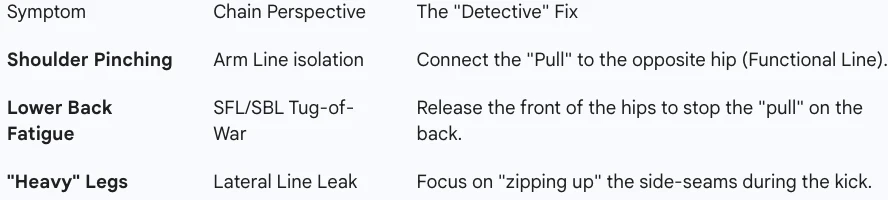
The power of your stroke (whether freestyle, fly, or breaststroke) doesn’t just come from your shoulders; it comes from the connection to your opposite hip.
- The Action: During the “catch” and pull-through, your Superficial Front Arm Line (chest and inner arm) connects to your Front Functional Line (the diagonal “X” across your belly).
- The Benefit: This allows you to pull the water using your entire torso. If this connection is strong, your arm acts like a paddle attached to a massive engine (your core).
- The Trap: “Swimmer’s Shoulder.” If the Arm Lines aren’t supported by the Functional Lines, the small rotator cuff muscles have to do 100% of the work. They eventually fray because they aren’t designed to pull your whole body weight through water.
2. The “Snap”: The Superficial Front Line (SFL)
This is especially vital for the Dolphin Kick and the start of the stroke.
- The Action: The SFL (the “shield” on the front of your body) acts like a whip. It stretches as you reach and then snaps shut to drive your legs down.
- The Benefit: It provides the “rhythm” of the stroke.
- The Trap: If your SFL is too tight (the “Short Wetsuit”), you can’t reach full extension. This “shortens” your stroke, meaning you have to take more strokes to cover the same distance, leading to faster fatigue.
3. The “Streamline”: The Lateral Line (LL)
The Lateral Line is what keeps you “long” and prevents your hips from “fishtailing” side-to-side.
- The Action: The LL on both sides of your body fires simultaneously to create a rigid, needle-like shape in the water.
- The Benefit: Less drag. A “loose” Lateral Line causes your legs to sway, which acts like a literal brake in the water.
- The Trap: If one side is tighter than the other (common in one-side breathers), you will find yourself constantly drifting toward one side of the lane.
4. The “Rotation”: The Spiral Line (SL)
Freestyle and backstroke are rotational sports.
- The Action: As one arm reaches, the opposite hip must rotate. This “wrings out” the Spiral Line.
- The Benefit: This rotation allows you to reach deeper and pull more water without over-extending the shoulder joint.
- The Trap: If your Spiral Line is “glued” (common in people with desk jobs), you will stay “flat” in the water. This forces your shoulders to do all the work and makes breathing much more difficult.
The Swimmer’s “Dry-Land” Reset
Do these before you get in the pool to “prime the tracks.”
- The “Streamline” Reach (Lateral Line): Reach both arms high, grab one wrist, and pull it toward the opposite side while pushing that hip out.
-
- Why: It clears the “side-seam” so you can stay straight in the water.
- The “Wall Rotation” (Spiral Line): Stand with your back to a wall. Keep your hips facing forward and rotate your chest to touch the wall with both hands.
-
- Why: It “un-glues” the torso so your hips and shoulders can rotate independently.
- The “Floor Cobra” (SFL): Lie on your belly and push your chest up while keeping your hips on the floor.
-
- Why: It unzips the front “shield,” allowing for a longer, more efficient stroke reach.
Summary for the Swimmer