For a runner, anatomy chains are the difference between “plodding” (using muscle power to fight gravity) and “gliding” (using fascial elasticity to bounce off the ground).
Running is essentially a series of coordinated falls and rebounds. Here is how the “Big 7” apply to your stride.
1. The “Spring”: The Superficial Back Line (SBL)
In running, the SBL is your energy storage system.
- The Action: When your foot hits the ground, your Achilles tendon and calves stretch. Because they are part of the SBL, that tension travels up to your hamstrings and back.
- The Benefit: If the SBL is “springy,” it catches that energy and snaps it back, propelling you forward without your muscles having to do all the work.
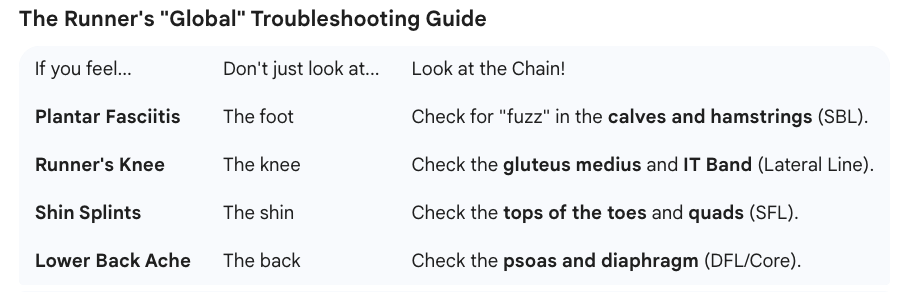
- The Runner’s Trap: If your calves are “stuck” or “glued” to the bone, the spring is broken. This is a common cause of Plantar Fasciitis—the “pull” is happening at the foot because the rest of the cable (calves/hamstrings) won’t budge.
2. The “Stabilizer”: The Lateral Line (LL)
Running is technically a “one-legged” sport.1 You are never on both feet at once.
- The Action: Every time you land, the Lateral Line on your outer leg “zips up” to keep your pelvis from dropping.
- The Benefit: It keeps your energy moving forward instead of “leaking” out to the side.
- The Runner’s Trap: This is where IT Band Syndrome comes from. If the Lateral Line isn’t stabilizing the hip properly, the IT Band (the lower part of the cable) gets over-tensioned and rubs against the knee.
3. The “Steering”: The Spiral Line (SL)
This is the most overlooked line for runners.
- The Action: As your right arm swings forward, your left leg swings back. The Spiral Line manages this “cross-body” rotation.2
- The Benefit: It prevents your knees from caving inward and keeps your feet tracking in a straight line.
- The Runner’s Trap: If the Spiral Line is tight on one side, you’ll notice one foot “flares out” or one knee “knocks” in. This creates an uneven wear-and-tear pattern, like a car with bad alignment.
4. The “Engine”: The Functional Lines
These are your power cables for speed.
- The Action: They connect the opposite shoulder and hip. When you drive your arm back, you are “charging” the opposite hip to drive forward.
- The Benefit: This is how sprinters generate explosive speed. Even for long-distance runners, these lines help maintain “form” when you get tired at the end of a race.
5. The “Pillar”: The Deep Front Line (DFL)
The DFL is the “Secret Sauce” of endurance.
- The Action: It connects your breathing (diaphragm) to your hip-swing (psoas).
- The Benefit: A healthy DFL allows for “rhythmic breathing.” When your psoas is fluid, your legs swing effortlessly under your torso.
- The Runner’s Trap: If you “grip” your abs too hard (thinking you’re doing “core work”), you lock the DFL. This makes your breathing shallow and your hip swing “choppy.”
The Runner’s “Global” Troubleshooting Guide
Runner’s Tip: The “Free Ride” Test
Next time you run, try to find the “bounce.”
- Imagine your Superficial Back Line is a giant rubber band from your heel to your head.
- Instead of “pushing” off the ground, try to feel the ground “pushing you” back up.
- If you feel “heavy,” your fascia is likely dehydrated or “stuck.” If you feel “light,” your chains are working together.