For a pitcher, the body isn’t just a collection of muscles; it is a biological whip. If a runner is a bouncing ball, a pitcher is a trebuchet.
The goal of pitching is to transfer energy from the ground, through the legs, across the torso, and out through the fingertips. In anatomy chains, this is the ultimate test of sequencing. If one link in the chain is “stuck” or “loud,” the energy leaks out, and the elbow or shoulder has to make up the difference (usually leading to surgery).
1. The Power Source: The Functional Lines
This is the “X” factor for velocity.
- The Action: As you stride toward the plate, your leading leg anchors into the ground. Your throwing arm is pulled back. This creates a massive diagonal stretch across your torso.
- The Secret: The Back Functional Line (connecting the glute of the drive-leg to the opposite shoulder) and the Front Functional Line (connecting the chest to the opposite hip) act like giant rubber bands.
- The Result: You aren’t “muscling” the ball with your pec or bicep; you are releasing the tension stored in the “X.”
2. The “Wind-Up”: The Spiral Line (SL)
Pitching is a game of extreme rotation.
- The Action: During the wind-up, you twist your torso away from the target. The Spiral Line wraps around your ribs and spine like a coiled spring.
- The Benefit: It provides the “centripetal force” needed to whip the arm around. It also stabilizes the landing knee so it doesn’t buckle under the force of the stride.
- The Pitcher’s Trap: If the Spiral Line is tight on one side, the pitcher will “fly open” too early, losing accuracy and velocity.
3. The Delivery: The Arm Lines
The arms are merely the end of the whip.
- The Action: The energy generated by the legs and core travels through the Deep Front Arm Line (the thumb side) and the Superficial Front Arm Line (the chest/palm).
- The Benefit: When these lines are fluid, the shoulder blade can glide freely on the ribcage.
- The Pitcher’s Trap: This is where UCL (Tommy John) issues start. If the “track” from the legs to the chest is blocked, the force of the throw gets “trapped” at the elbow. The elbow becomes the “victim” of a “culprit” in the hip or chest.
4. The Brake: The Superficial Back Line (SBL)
What goes forward must be slowed down.
- The Action: After the ball is released, the body has to decelerate the arm so it doesn’t fly off the shoulder.
- The Role: The SBL (the back of the legs and spine) acts as the “deceleration brake.”
- The Pitcher’s Trap: If a pitcher has tight hamstrings or a stiff lower back (SBL), they can’t “follow through” properly. Their arm has to “jerk” to a stop, which leads to shoulder labrum tears.
The Pitcher’s “Global” Troubleshooting Guide
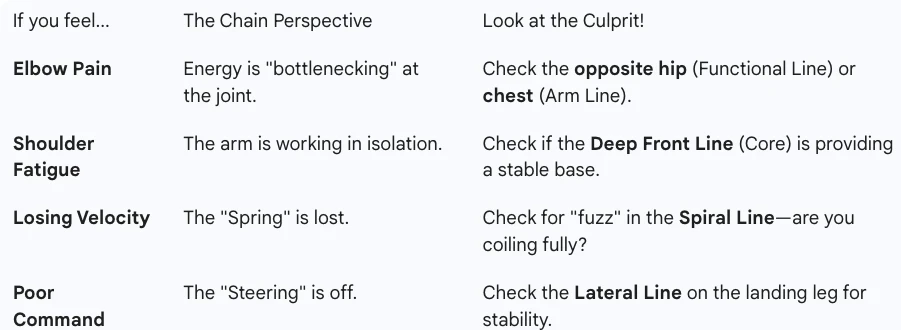
Pitcher’s Tip: The “Whip” Check
To maximize velocity and safety, focus on the Front Functional Line (chest to opposite inner thigh).
- In your wind-up, feel the stretch across your belly.
- If you feel “pinched” in your shoulder, it means the chain is broken at the chest.
- By “melting” the chest fascia, you allow the “whip” to be longer and faster.
Summary for the Pitcher
A pitcher who uses their muscles will eventually “blow out” an arm. A pitcher who uses their chains uses the entire weight of their body to move a 5-ounce ball.