Jazz dance is a unique test for the anatomy chains because it demands a rare combination of extreme flexibility (long lines) and explosive power (jumps and turns). In jazz, you aren’t just moving; you are “syncopating” your body. If your chains are “stuck,” your movement looks stiff and “muscular” rather than fluid and rhythmic.
Here is the breakdown of the “Jazz Dancer’s Map.”
1. The “Kick and Leap”: The Superficial Front Line (SFL)
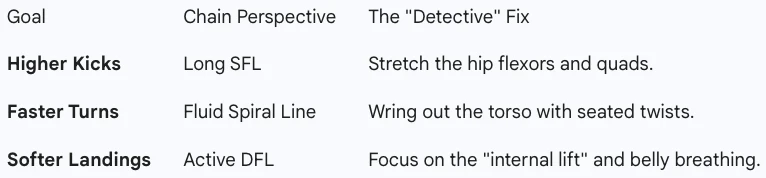
In jazz, the SFL is responsible for those high “battements” (kicks) and the “snap” in jumps.
- The Action: The SFL must be able to lengthen instantly to allow the leg to fly up, and then contract powerfully to control the descent.
- The Benefit: A fluid SFL creates that “effortless” look in jumps.
- The Dancer’s Trap: If the SFL is too tight (especially the hip flexors), the dancer will “pitch” their torso forward during a kick. The “short wetsuit” at the hip prevents the leg from going high without pulling the spine out of alignment.
2. The “Syncopated Twist”: The Spiral Line (SL)
Jazz is famous for “isolations”—moving the ribs while the hips stay still.1 This is the ultimate playground for the Spiral Line.
- The Action: The Spiral Line wraps around the torso like a candy cane. It allows the dancer to rotate the ribcage independently of the pelvis.
- The Benefit: This creates the “torque” needed for multiple pirouettes and the classic “jazz character” in movements.
- The Dancer’s Trap: If the Spiral Line is “glued,” the dancer moves as one solid block. They lose the ability to isolate, and their turns become wobbly because the “X” of the torso isn’t coordinating the rotation.
3. The “Turnout and Balance”: The Lateral Line (LL)
Whether in a “jazz second” or balancing on one leg, the Lateral Line is the stabilizer.
- The Action: The LL (outer hip and side-body) keeps the pelvis level while the other leg is moving through space.
- The Benefit: It prevents “hip-popping.” A strong Lateral Line allows a dancer to stay perfectly vertical even when moving at high speeds.
- The Dancer’s Trap: This is where “Snapping Hip” or IT Band issues come from. If the Lateral Line is over-taxed because the core (DFL) isn’t helping, the outer hip fascia becomes tight and “clicks” over the bone.
4. The “Internal Lift”: The Deep Front Line (DFL)
In the dance world, they call this “pulling up.” In anatomy, it’s the Deep Front Line.
- The Action: The DFL provides the “buoyancy” that makes a dancer look light on their feet. It connects the arches of the feet to the pelvic floor and up through the crown of the head.
- The Benefit: When the DFL is “on,” the dancer has a “high center of gravity,” making it easier to move quickly and land jumps softly.
- The Dancer’s Trap: If a dancer tries to find stability by “clinching” their glutes or abs (outer lines), they lose their bounce. They become “bottom-heavy,” and their landings become loud and jarring.
The Jazz Dancer’s “Backstage” Reset
Do these between classes or after a performance to “clear the tracks.”
- The “Big Toe Press” (DFL): While standing, focus on pressing the big toe into the floor without “scrunching” the others.
-
- Why: This “plugs in” the Deep Front Line, giving you instant stability for turns.
- The “Rib-to-Hip” Spiral (SL): Sit on the floor, legs in a “Z” shape. Rotate your chest away from your front leg.
-
- Why: It unzips the Spiral Line, allowing for better “isolations” and cleaner turns.
- The “Foot Arch Melt” (SBL): Use a tennis ball under the arch of the foot.
-
- Why: Dancers spend hours in “relevé” (on their toes). Releasing the anchor of the Back Line at the foot prevents the tension from traveling up to the lower back.
Summary for the Jazz Dancer