In Brazilian Jiu-Jitsu (BJJ), you aren’t just moving yourself—you are constantly managing the weight and tension of another human being. This is where Anatomy Chains go from being a fitness concept to a survival tool.
BJJ is essentially “Fascial Warfare.” If you can keep your chains connected while “unzipping” or “breaking” your opponent’s chains, you win.
1. The “Guard” and the Deep Front Line (DFL)
If you are playing guard, your Deep Front Line is your life insurance policy.
- The Action: The DFL connects your inner thighs (adductors) to your pelvic floor and deep core.
- The Benefit: When this line is “on,” your legs feel incredibly heavy and difficult to pass. It’s that “internal lift” we talked about—it keeps your spine protected even when you’re being stacked.
- The Trap: If you rely only on your “six-pack” (SFL) to hold someone in guard, you will gas out quickly. The SFL is a “sprint” muscle; the DFL is an “endurance” pillar.
2. The “Bridge” and the Superficial Back Line (SBL)
Escaping from mount or side control requires a powerful bridge, which is the ultimate SBL move.
- The Action: You drive through your heels, firing the chain from your arches, through your hamstrings and glutes, all the way up to your neck.
- The Secret: A good bridge isn’t just glute strength. It’s the ability of the Superficial Back Line to act as one solid, unyielding cable. If there is “slack” in your lower back or neck, the bridge “leaks” energy, and your opponent stays heavy.
3. “Snake Moves” and the Spiral Line (SL)
Shrumping (hip escaping) and technical stand-ups are pure Spiral Line movements.
- The Action: You are rotating your hips one way while your shoulders stay fixed, or vice versa.
- The Benefit: The Spiral Line allows you to create “frames” and angles. In BJJ, the person with the better angles wins.
- The Trap: If your Spiral Line is “glued,” you will move like a block of wood. You’ll try to hip escape using only your leg muscles, which is slow and exhausting.
4. Submissions and the Arm Lines
Whether you are finishing a Kimura or a RNC (Rear Naked Choke), the Arm Lines are your “manipulators.”
- The Action: You are often pulling someone’s limb toward your core.
- The Secret: Never pull with just your arms. Connect your Arm Lines to your Functional Lines. A Kimura shouldn’t be “bicep vs. shoulder”; it should be your “entire torso and opposite hip vs. their shoulder.”
- The Trap: This is where BJJ practitioners get “Golfer’s Elbow.” They pull using only the small muscles of the forearm because the “track” to their core is blocked at the chest.
BJJ “Global” Injury Prevention
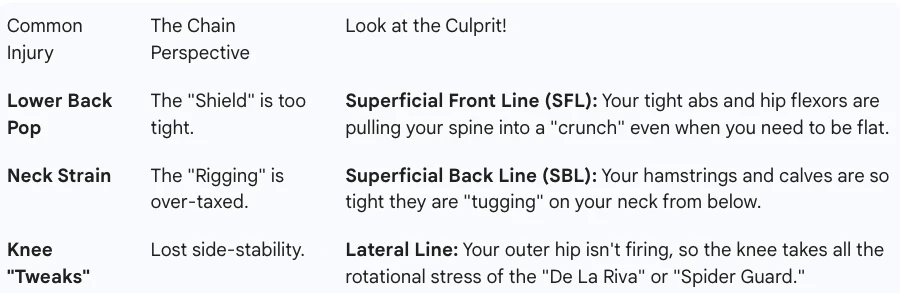
The BJJ “Fascial” Strategy: “The Wet Noodle”
The most dangerous players are often the ones who feel “heavy but loose.”
- They keep their Deep Front Line (Core) pressurized and strong.
- They keep their Outer Lines (SBL/SFL) relaxed until the moment they need to “snap” a submission.
- By staying “fluid,” they don’t give their opponent any “handles” (tension) to grab onto.
BJJ is a unique test of these chains because it’s so chaotic.