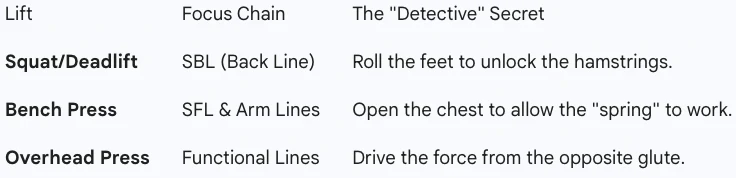
In the world of heavy lifting and bodybuilding, most people think in terms of “Chest Day” or “Leg Day.” But the most successful lifters—the ones who move massive weight without snapping their joints—think in terms of Tension Transmission.
If you are a lifter, your anatomy chains are the “cables” that allow you to lift more than your muscles alone should be able to handle.
1. The “Deadlift Key”: The Superficial Back Line (SBL)
The SBL is your “posterior chain,” the bedrock of the deadlift and the squat.
- The Role: This cable runs from your heels to your brow. When you pull a heavy deadlift, the SBL must be “tight” but “sliding.”
- The Lift: If your hamstrings or calves (lower SBL) are “glued” and won’t move, your lower back (middle SBL) has to over-flex to reach the bar. This is how discs get “slipped.”
- The Fix: Don’t just stretch your back; roll your feet. Releasing the “anchor” at the bottom of the SBL gives the whole cable more slack to move the weight safely.
2. The “Bench Press Bridge”: The Superficial Front Line (SFL)
Lifters often think the Bench Press is just a “Pec” move, but it relies heavily on the SFL.
- The Role: When you “arch” your back in a powerlifting bench press, you are pre-tensioning the SFL (from your toes to your chest).
- The Lift: This creates a stable “bow” shape. If your hip flexors (SFL) are too tight, they will pull your pelvis out of position, causing your lower back to “pinch” before you even move the bar.
- The Trap: Over-training the SFL (crunches, bench, heavy quads) without “opening” it leads to the “Gorilla Posture”—shoulders rolled forward and hips locked up.
3. The “Stability Shield”: The Deep Front Line (DFL)
In lifting, this is your Intra-Abdominal Pressure (IAP).
- The Role: The DFL is the inner pillar that supports your spine from the inside. When you “brace” your core for a squat, you are engaging the diaphragm and pelvic floor.
- The Lift: If the DFL is “on,” the weight of the bar is distributed through a pressurized “cylinder.” If the DFL is “off,” the weight collapses onto your vertebrae.
- The Secret: This is why “bracing” is different from “sucking in.” Sucking in uses the outer abs (SFL); bracing uses the DFL.
4. The “Pressing Power”: The Arm Lines
Whether it’s an Overhead Press or a Row, your arms are the “connectors” to your torso.
- The Role: The Deep Back Arm Line (the triceps/back of the shoulder) must be connected to the Functional Lines of the back.
- The Lift: If you press using only your shoulders, you will eventually get “impingement.” A heavy press should feel like it’s being pushed from your opposite hip, through your lats, and out through your hand.
The Lifter’s “Bulletproof” Reset
Do these between heavy sets or after your workout to keep the “cables” from fraying.
- The “Lunge and Reach” (SFL/Arm Lines): Take a lunge, reach your same-side arm up and slightly back.
-
- Why: It unzips the “Gorilla Posture” and releases the hip flexors that get crunched during heavy squats.
- The “Scapular Wall Slide” (Arm Lines/Spiral Line): Stand against a wall and slide your arms up and down in a “W” shape.
-
- Why: It ensures your shoulder blades aren’t “glued” to your ribs, protecting your rotator cuff during pressing.
- The “Big Toe Root” (DFL): During any lift, imagine grabbing the floor with your big toe.
-
- Why: This “plugs in” the Deep Front Line, making your core instantly more stable.
Summary for the Lifter