Ballet is the ultimate expression of distal precision supported by proximal stability. While a jazz dancer might be more explosive and syncopated, a ballerina lives in a world of “Turnout” and “Extension.” The unique challenge of ballet is that it asks the body to operate at the very end of its ranges (like en pointe or extreme turnout) for hours on end. This creates specific “fascial signatures” in the chains.
1. The “Turnout” Engine: The Deep Front Line (DFL)
In ballet, turnout isn’t just about the feet; it’s about the deep hip rotators and their connection to the core.
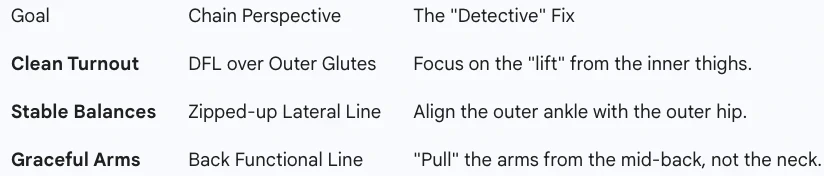
- The Action: The DFL includes the deep hip rotators and the psoas. In ballet, this chain must remain “on” to maintain the external rotation of the femur without “gripping” the big glute muscles.
- The Benefit: If the DFL is doing the work, the legs feel “long” and free. If the dancer uses the “outer” lines to force turnout, the hips feel “pinched” and the movement looks labored.
- The Risk: If the DFL collapses, the arches of the feet fall, and the “screwing” force travels directly into the medial knee, leading to meniscus or ligament issues.
2. The “Vertical Axis”: The Lateral Line (LL)
Ballet is obsessed with the “center.” Whether in croisé or effacé, the Lateral Line is what keeps the dancer from “leaning” into the barre or the floor.
- The Action: The LL must act like a tight guy-wire on a tent pole. It stabilizes the ribs over the pelvis and the pelvis over the standing leg.
- The Benefit: A high, stable “side-seam” allows for the iconic “long neck” and dropped shoulders of a ballerina.
- The Risk: “Bunions” and Ankle Sprains. If the Lateral Line isn’t “zipping up” from the outer ankle through the hip, the weight falls onto the inside of the foot, shoving the big toe out of alignment.
3. The “Port de Bras”: The Arm Lines
The grace of a ballerina’s arms comes from the ability to move the limbs without disturbing the spine.
- The Action: The Deep Front Arm Line (thumb side) and Superficial Back Arm Line (top of the shoulder/arm) must be soft but energized.
- The Insight: The arms should feel like they are growing out of the mid-back (the lats). This connects the arms to the “Functional Lines” and the core.
- The Risk: If a ballerina “lifts” from the tops of her shoulders, she creates tension in the neck, which “breaks” the line of the silhouette and causes chronic upper-back knots.
4. The “En Pointe” Anchor: The Superficial Back Line (SBL)
Standing on the tips of the toes is the most extreme test of the SBL.
- The Action: The entire back of the leg and foot is in a state of maximal contraction and compression.
- The Benefit: A strong SBL allows for a powerful relevé and the ability to balance on a tiny point of contact.
- The Risk: Plantar Fasciitis and Achilles Tendonitis. Because the SBL is one cable, the extreme tension at the toes “tugs” on the calves and hamstrings. If the “fuzz” isn’t cleared out, the tissue becomes brittle and prone to micro-tears.
The Ballerina’s “After-Rehearsal” Reset
Ballet “molds” the body into a specific shape. These moves help “un-mold” it so you don’t stay stuck in the turnout.
- The “Big Toe Release” (SBL/DFL): Place a small ball under the ball of the foot and gently spread your toes over it.
-
- Why: It releases the “pinch” from the pointe shoes and resets the DFL’s connection to the floor.
- The “Internal Rotation” Reset (Spiral Line): Sit on the floor and turn your knees inward (the opposite of turnout).
-
- Why: This provides “counter-tension” to the Spiral Line and deep hip rotators, preventing the “locked-out” hip feeling.
- The “Pec Minor Release” (Arm Lines): Use a tennis ball against a wall to massage the area just below your collarbone.
-
- Why: It allows the shoulders to drop back and down, restoring the “Long Neck” without straining.
Summary for the Ballerina