Cycling is a fascinating case because it is a “closed-loop” sport. Your feet are clipped into pedals, your hands are fixed on bars, and your pelvis is on a saddle. This creates a highly efficient circuit, but if there is a “short” in any of your anatomy chains, the repetitive nature of the stroke (thousands of reps per ride) will find it very quickly.
Here is the breakdown of the “Cycling Circuit.”
1. The “Power Stroke”: The Superficial Front Line (SFL)
In cycling, the SFL is the engine that drives the downward phase of the pedal stroke.
- The Culprit: Because you are in a “tucked” aero position, the SFL (specifically the hip flexors and quads) is constantly in a shortened state.
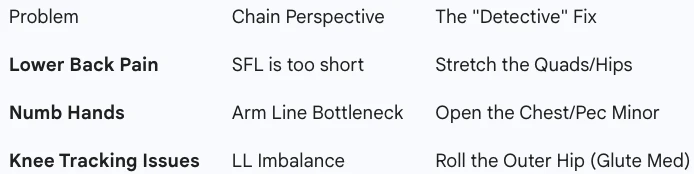
- The Result: The fascia “sets” in this short position. When you get off the bike, you might find it hard to stand fully upright. This “short” front line pulls your pelvis forward, which is why so many cyclists suffer from lower back pain—the back muscles are being pulled like a bowstring.
2. The “Stability Anchor”: The Lateral Line (LL)
The Lateral Line is what keeps your knees from “hunting” (wobbling side-to-side) as you pedal.
- The Culprit: If the LL (the outer hip and IT band) is too tight, it pulls the knee outward. If it’s too weak, the knee caves inward.
- The Result: This leads to the classic “Cyclist’s Knee.” It’s rarely a knee problem; it’s a failure of the Lateral Line to stabilize the hip while the leg is under high load.
3. The “Aero Hunch”: The Superficial Back Line (SBL)
While the front is shortening, the back of the body is being stretched over the frame of the bike.
- The Culprit: The SBL is held in a long, taut position from the tailbone to the base of the skull.
- The Result: This puts the neck in “overdrive.” To look at the road while your body is tucked, the SBL at the neck has to crank the head up. This is the source of “Shermer’s Neck” or general neck fatigue.
- The Fix: Releasing the Plantars (feet) and Calves actually provides slack to the neck. If the “bottom” of the cable is loose, the “top” (the neck) doesn’t have to pull so hard.
4. The “Handlebar Grip”: The Arm Lines
Your arms aren’t just steering; they are bracing your entire upper body.
- The Culprit: The Deep Front Arm Line (the thumb side) and the Superficial Front Arm Line (the chest) are under constant isometric tension.
- The Result: This “tethers” your ribcage. If your chest is tight, your Deep Front Line (Core) can’t expand for big breaths. You essentially “suffocate” your own engine because your Arm Lines are too tight.
The “Post-Ride” Reset Routine
Do these as soon as you get off the bike to prevent the “Cycling Mold” from setting.
- The “Couch Stretch” (SFL): Put one foot up on a couch or chair behind you, kneeling on the other. Tuck your tailbone.
-
- Why: This unzips the hip flexors and quads, releasing the “pull” on your lower back.
- The “Doorway Pec Stretch” (Arm Lines): Open the chest to allow the lungs to recover.
-
- Why: It releases the “Aero Hunch” and allows the Deep Front Line (diaphragm) to finally move freely.
- The “Downward Dog” (SBL): A classic move that stretches the entire back cable.
-
- Why: It resets the length of the hamstrings and calves after they’ve been in a mid-range “pump” for hours.
Summary for the Cyclist